What Is Long-Duration Energy Storage? – Beyond Four Hours
Four hours. That's how long most grid batteries can run at full power before they're empty, and for daily jobs like shifting solar into the evening peak, it works well. But a grid or an off-grid site that leans heavily on wind and solar eventually meets a week of clouds and calm air. Four hours doesn't go far in a week. That gap is why engineers and planners keep talking about storage that lasts much longer. What is long-duration energy storage, and what can it do that an ordinary battery can't?
Long duration energy storage (LDES) refers to systems that can deliver power for many hours to days, generally 10 hours or more, well beyond the roughly four hours typical of lithium-ion grid batteries. Pumped storage hydropower is the oldest and largest example, and newer options include compressed air, flow batteries, iron-air batteries, thermal storage and hydrogen.
Their job is to cover overnight gaps, multiday weather lulls and, eventually, seasonal swings. Most trade lower round-trip efficiency for much cheaper energy capacity, so they make sense where storage cycles less often but needs to last longer. Outside pumped hydro, most LDES technologies are still early in commercial deployment.
What Counts as Long-Duration Energy Storage?
Long-duration energy storage has no single official cutoff, but the U.S. Department of Energy (DOE) generally uses 10 hours or more. Its Pathways to Commercial Liftoff report on long duration storage uses that definition and estimates the country may need 225 to 460 GW of LDES by 2050. Others use eight hours, or anything beyond four.
It helps to think in three bands:
- Intraday (about 4 to 10 hours): Covering the evening and overnight after the sun sets.
- Multiday (about 10 to 100+ hours): Riding through several days of weak wind and solar.
- Seasonal (weeks to months): Moving summer surplus into winter. Very few technologies are economic here today.
One quick clarity check on units. Duration is energy divided by power. A 100 MW system holding 400 MWh is a four-hour battery. A 100 MW system holding 10,000 MWh is a 100-hour system. Same power rating, very different job.
Why Do Most Batteries Stop at Four Hours?
Most grid batteries stop at four hours because that duration earns full credit in many capacity markets and covers the daily evening peak, while every extra hour of lithium-ion storage costs nearly as much as the last. California's resource adequacy rules, for example, have long credited four-hour storage as able to meet peak demand, and many other planning studies adopted the same benchmark.
The cost structure explains the rest. In a lithium-ion system, the battery cells are the largest cost, and you need more cells for every added hour. Doubling duration roughly doubles the biggest part of the bill. That's fine for a few hours. It gets painful at 24, and absurd at 100.
Long-duration technologies flip that structure. They often have expensive power equipment (pumps, turbines, cell stacks) but very cheap energy storage (water in a reservoir, air in a cavern, iron in a tank). Adding hours costs little, so long durations become affordable.
What Technologies Provide Long-Duration Storage?
The main long-duration technologies are pumped hydro, compressed air, flow batteries, metal-air batteries, thermal storage and hydrogen. The table below gives approximate, typical ranges; real projects vary by design.
| Technology | How it stores energy | Typical duration | Rough round-trip efficiency |
|---|---|---|---|
| Pumped storage hydro | Pumps water uphill, releases it through turbines | 6 to 20+ hours | About 70% to 80% |
| Compressed air | Compresses air into caverns, expands it through turbines | 8 to 24+ hours | About 40% to 70%, design dependent |
| Flow batteries | Liquid electrolytes in tanks, pumped through a cell stack | 6 to 12+ hours | About 60% to 75% |
| Iron-air and other metal-air | Rusting and un-rusting iron | Up to about 100 hours | Lower, roughly 40% to 50% |
| Thermal storage | Heats rock, salt or other media, recovers heat for power | Hours to days | Varies widely |
| Hydrogen | Electrolysis, storage, then fuel cell or turbine | Days to seasons | Low, roughly 30% to 40% |
Pumped Hydro Is Already the Giant
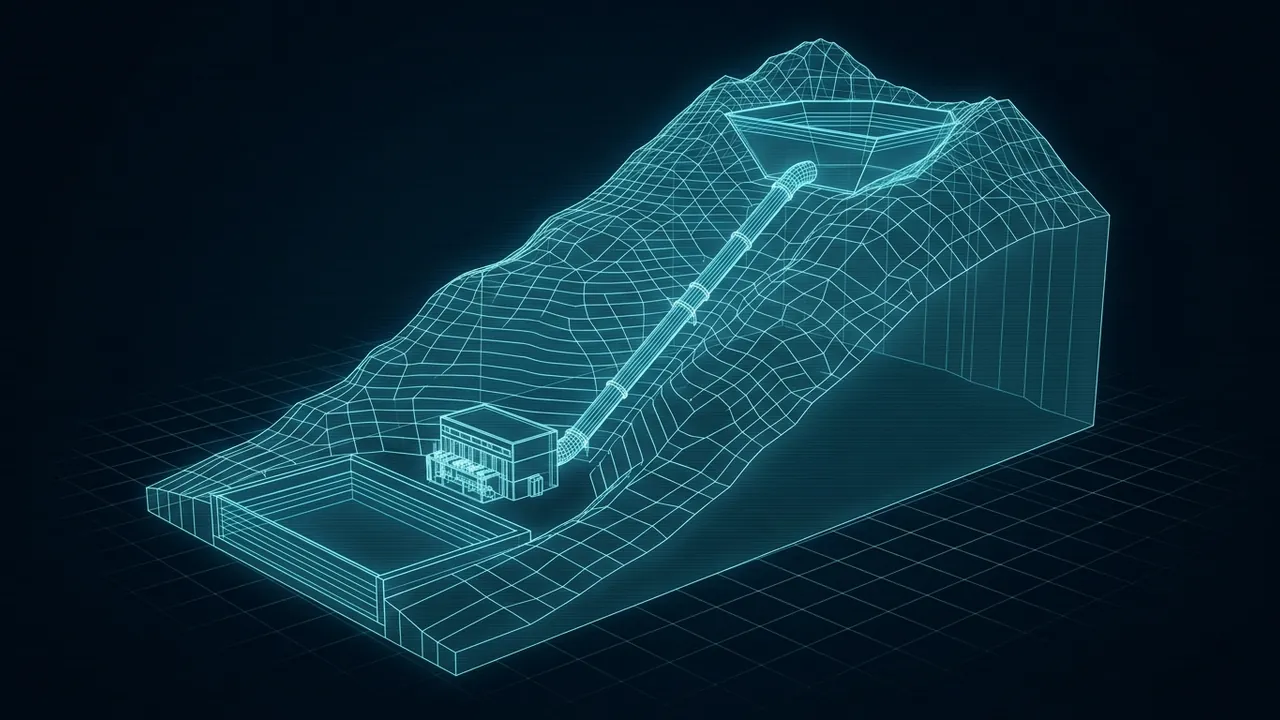
Pumped storage hydropower has long been the largest form of grid energy storage in the United States and worldwide. The Bath County Pumped Storage Station in Virginia, rated around 3 GW, is one of the biggest in the world. Its weakness is geography: it needs two reservoirs at different elevations, years of permitting and a lot of concrete.
Compressed Air Has a Long Track Record Too
Compressed air storage plants have run for decades. Germany's Huntorf plant opened in 1978, and the McIntosh plant in Alabama has operated since 1991. Both use underground salt caverns. Newer designs aim to store the heat of compression so they don't need to burn natural gas during discharge.
How Do Long-Duration Storage Economics Work?
Long-duration storage economics hinge on cost per kWh of storage capacity, because those systems hold so much energy. Compare two hypothetical ways to carry a 10 MW load through a three-day lull.
- Energy needed: 10 MW × 72 hours = 720 MWh, or 720,000 kWh.
- Lithium-ion at an assumed $300 per kWh of capacity: 720,000 × $300 = $216 million.
- A hypothetical long-duration system with $30 per kWh energy cost plus $1,500 per kW of power equipment: (720,000 × $30) + (10,000 kW × $1,500) = $21.6 million + $15 million = $36.6 million.
The long-duration system wins easily on capital, even though it might lose a quarter or more of its stored energy to inefficiency. DOE's Liftoff analysis frames the target the same way, aiming for multiday systems around $1,100 per kW of capacity by 2030. Spread over 100 hours, that's about $11 per kWh of storage.
Why Does Round-Trip Efficiency Matter Less for Long Storage?
Round-trip efficiency matters less for long-duration storage because these systems cycle less often and usually charge on very cheap energy. A four-hour battery might cycle every day. A 100-hour system might fully cycle only a few dozen times a year.
Consider charging with surplus solar or wind priced at $10 per MWh. At 50% round-trip efficiency, each MWh delivered costs $10 ÷ 0.5 = $20 in charging energy. At 85%, it costs about $11.80. The gap is real but small compared with the capital savings above. Efficiency matters a lot for daily cycling and much less for rare, long discharges.
What Are the Risks of Betting on Long-Duration Storage?
The main risks are technology maturity, revenue and footprint. Apart from pumped hydro and a few compressed air plants, most long-duration systems have short operating histories at commercial scale. Lenders and insurers want years of field data on degradation, availability and maintenance before they treat a technology like a known quantity.
Revenue is the second problem. A system that discharges a few dozen times a year has to earn its keep in those few events, and many power markets don't yet pay well for multiday reliability. Projects often depend on long-term contracts with utilities or large buyers who value that insurance.
Finally, cheap energy capacity can still mean big equipment. Tanks of electrolyte, rows of iron-air modules or a pair of reservoirs take real land, so siting and permitting deserve early attention.
Where Does Long-Duration Storage Fit for Data Centers and Remote Sites?
Long-duration storage fits where a site wants to cut generator hours during multiday lulls without burning fuel. For a data center contracting clean power, it can firm up wind and solar so they cover more hours of the year. For an off-grid hybrid, it could someday replace the generator's job during a cloudy week.
Today, the honest picture is more modest. Lithium-ion still covers most short-duration needs, and generators or grid connections cover the long tail. If you're comparing options, start with the cost of conventional batteries, which we break down in an article on battery storage cost per MWh. Then ask whether your problem is really hours or days. That answer decides whether LDES belongs on your shortlist.
Long Duration Energy Storage Earns Its Keep in the Worst Week

What is long duration energy storage? It's storage built to discharge for 10 hours or more, sometimes 100, using pumped water, compressed air, liquid electrolytes, iron, heat or hydrogen instead of more lithium-ion cells. Its purpose is to cover the long gaps that four-hour batteries can't.
The trade-offs are consistent. LDES usually gives up efficiency to gain cheap energy capacity, which suits systems that discharge rarely but for a long time. Pumped hydro proves the concept at huge scale; most newer technologies are still building their track records.
For anyone designing a high-renewable grid or off-grid system, the useful exercise is to find your worst multiday stretch in the weather data and price three ways to cover it: more batteries, a generator, or a long-duration system. If the generator wins today, design the site so it could hand that job to storage later. When you talk to LDES vendors, ask for operating hours and availability data from installed systems, not just lab results.