What Are Mobile Gas Turbines? – Trailer-Mounted Power Explained
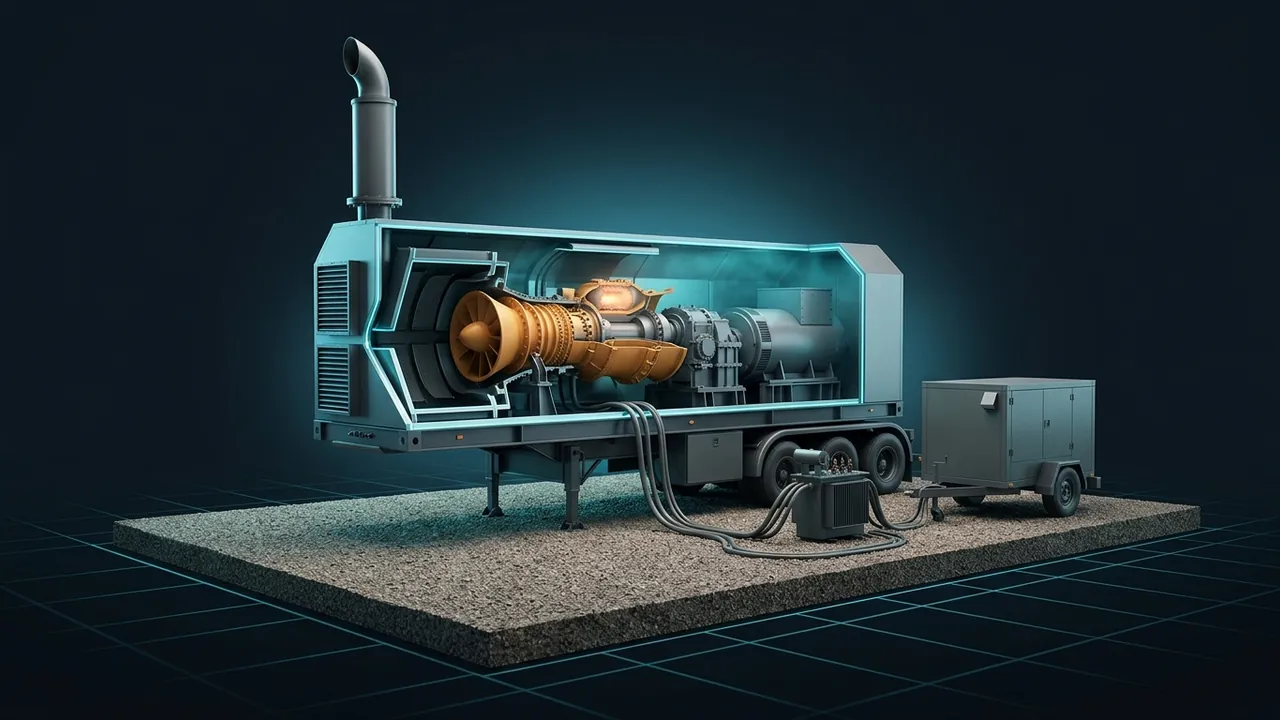
Most power plants take years to build and never move an inch. A mobile gas turbine flips both of those rules. It rolls in on a highway trailer, sets up on a gravel pad, and can be making megawatts within days, then pack up and leave when the job is done. Utilities, oilfield operators, mines and large industrial sites all keep them in mind for the moment they need power fast. What are mobile gas turbines, and when do they make sense?
A mobile gas turbine is a complete gas turbine generator set built onto one or more road trailers, with its own enclosure, controls and electrical equipment, so it can be moved and set up quickly wherever power is needed. Most are aeroderivative or small industrial turbines, ranging from about 5 MW to roughly 35 MW per unit.
They are used for emergency power, bridge power before a permanent plant or grid connection is ready, oilfield work, remote mines and seasonal peaks. The trade-offs are higher fuel use than large stationary plants, high fuel pressure needs, and the cost of renting or owning a machine built for speed rather than efficiency.
How Does a Mobile Gas Turbine Work?
A mobile gas turbine works exactly like a stationary one. It draws in air, compresses it, burns natural gas or liquid fuel in it, and expands the hot gas through turbine blades that spin a generator. What changes is the packaging.
Everything a small power plant needs is fitted onto trailers:
- The turbine and generator on a common frame inside a sound-insulated enclosure.
- An air inlet filter house and an exhaust stack that folds down for travel and raises on site.
- A control room or control trailer with the turbine controls, protection relays and communications.
- Switchgear, and often a trailer-mounted step-up transformer.
- Auxiliary systems such as lube oil, fire protection and starting equipment.
Designers keep each trailer within highway weight and size limits, which is why the turbines chosen are light and compact. Aeroderivative turbines, built from jet engine designs, are a natural fit.
How Big Are Mobile Gas Turbines?
Mobile units cluster in two size groups. Smaller industrial turbines on a single trailer make roughly 5 to 16 MW. Aeroderivative units spread across a few trailers make roughly 25 to 35 MW.
Solar Turbines, for example, describes its mobile turbomachinery line as including a single-trailer SMT60 unit built on its Taurus 60 turbine at about 5.7 MW, with setup in under six hours, and a larger SMT130 mobile plant based on the Titan 130 at about 16 MW. In the larger class, GE's TM2500 is a trailer-mounted version of its LM2500 aeroderivative in the 30 MW range.
| Class | Typical output per unit | Trailers | Typical use |
|---|---|---|---|
| Small industrial turbine | About 5 to 8 MW | Often one | Oilfield, remote sites, small industrial loads |
| Mid industrial turbine | About 10 to 16 MW | One to a few | Mines, larger industrial sites, peaking |
| Aeroderivative | About 25 to 35 MW | Several | Utility emergencies, bridge power, large loads |
For bigger needs, operators simply line up several units in parallel. Ten 30 MW units on one pad is a 300 MW plant that did not exist a month earlier.
What Are Mobile Gas Turbines Used For?
Mobile gas turbines fill gaps: places or times where power is needed sooner than a permanent plant or grid connection can provide it.
- Disaster recovery: restoring power after hurricanes, floods or major equipment failures.
- Grid support: backing up a substation or region during maintenance, outages or heat waves.
- Bridge power: running a new facility until its permanent plant or utility connection is finished.
- Oilfield operations: powering electric hydraulic fracturing fleets, drilling rigs and production facilities, often on field gas.
- Mines and remote industry: sites far from transmission lines.
- Plant outages: standing in while a permanent unit is overhauled.
How Fast Can One Be Set Up?
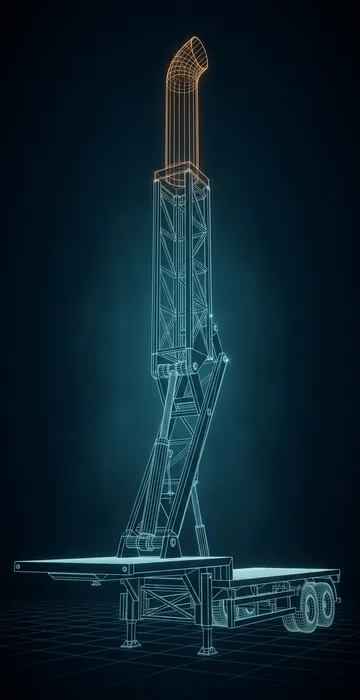
The turbine itself can be ready quickly. Manufacturers advertise setup times measured in hours or days once the trailers are parked. The real schedule usually depends on everything around the unit:
- Site prep: a level, compacted pad that can bear heavy trailers, with access for trucks.
- Fuel connection: a gas tap with filtration, pressure regulation and metering, and often a gas compressor, since turbines need higher pressure than most distribution lines provide.
- Electrical connection: a step-up transformer and protection that ties into the local grid or the facility's switchgear.
- Permits: air permits, sometimes temporary, and local approvals. Requirements vary by state and duration, so check with your state air agency.
- Commissioning: testing protection, controls and load response before the unit carries critical load.
On a prepared site with gas and an electrical tie already in place, a mobile unit can be producing power in days. On a bare field, the gas lateral and interconnection can take far longer than the turbine.
How Much Gas Does a Mobile Turbine Burn?
More per MWh than a large stationary plant, because small simple-cycle turbines are less efficient. Here is a worked example for a 30 MW unit at an illustrative heat rate of 10,000 Btu/kWh:
- Daily output: 30 MW × 24 h = 720 MWh = 720,000 kWh.
- Fuel: 720,000 kWh × 10,000 Btu/kWh = 7,200 million Btu (MMBtu) per day.
- Gas volume at about 1,036 Btu per cubic foot: 7,200,000,000 ÷ 1,036 ≈ 6.95 million cubic feet per day (MMcf/d).
That is roughly 290 Mcf (thousand cubic feet) every hour for one unit. Line up several and you need a serious gas line. Because these units are often called in for emergencies, a plan for firm gas supply matters: interruptible pipeline service can be cut at exactly the moment the turbines are needed most. Many mobile turbines are dual-fuel and can switch to diesel, which gives a backup when trucked fuel can reach the site.
What Are the Limits?
Speed has a price. Before counting on mobile turbines, plan for these limits:
- Efficiency: simple-cycle mobile units burn more fuel per MWh than combined-cycle plants or large gas engines.
- Fuel pressure: turbines typically need gas at high pressure, which may require compression on site.
- Hot weather: like all gas turbines, output drops as temperature and elevation rise.
- Emissions: units often use water injection or other controls to limit nitrogen oxides (NOx). The EPA's long-standing guidance on NOx control for gas turbines describes water and steam injection as one of the main techniques, which means a treated water supply on site.
- Noise: enclosures help, but turbine inlets and exhausts are loud, which matters near homes.
- Cost: rental rates and mobilization fees are high compared with the fuel and maintenance cost of a permanent plant.
Mobile Turbine vs Diesel Rental Generators
For small and short jobs, a row of rented diesel gensets is often the simpler answer. Diesel units start fast, take sudden loads well and need no gas line, just fuel trucks. The trouble starts as the job gets bigger and longer. A 30 MW load on diesel might take a dozen or more large gensets, a steady parade of tanker trucks and a lot of fuel spending.
A mobile gas turbine packs that output into a few trailers and runs on pipeline or field gas, which usually costs less per unit of energy and emits fewer particulates. The crossover depends on load size, duration and whether gas is available at the site. As a rough guide, the bigger the load and the longer the job, the stronger the case for the turbine.
Should You Rent, Lease or Buy?
It depends on how long you need the power. Renting suits short jobs, from weeks to a year or so, where you want the provider to handle transport, maintenance and operators. Leasing fits multi-year bridge needs. Buying makes sense when you expect to move units between your own sites over many years, as some oilfield and utility fleets do.
Whatever the deal, pin down who supplies the operators, who pays for fuel and overhauls, what output is guaranteed at your site temperatures, and how quickly a replacement unit arrives if one fails.
Power Plants on Wheels: When a Mobile Gas Turbine Fits
A mobile gas turbine is a full turbine generator set on trailers, built to roll in, connect and run in days rather than years. Units range from about 5 to 35 MW, and several can be combined for larger loads.
They fit emergencies, bridges and remote or temporary work, where speed is worth more than efficiency. The trailers are the easy part to schedule. Before they roll in, make sure the pad is prepared, the gas supply has enough pressure and firmness, and the electrical connection is ready to take the power.