Why Data Center Siting Now Starts With Power
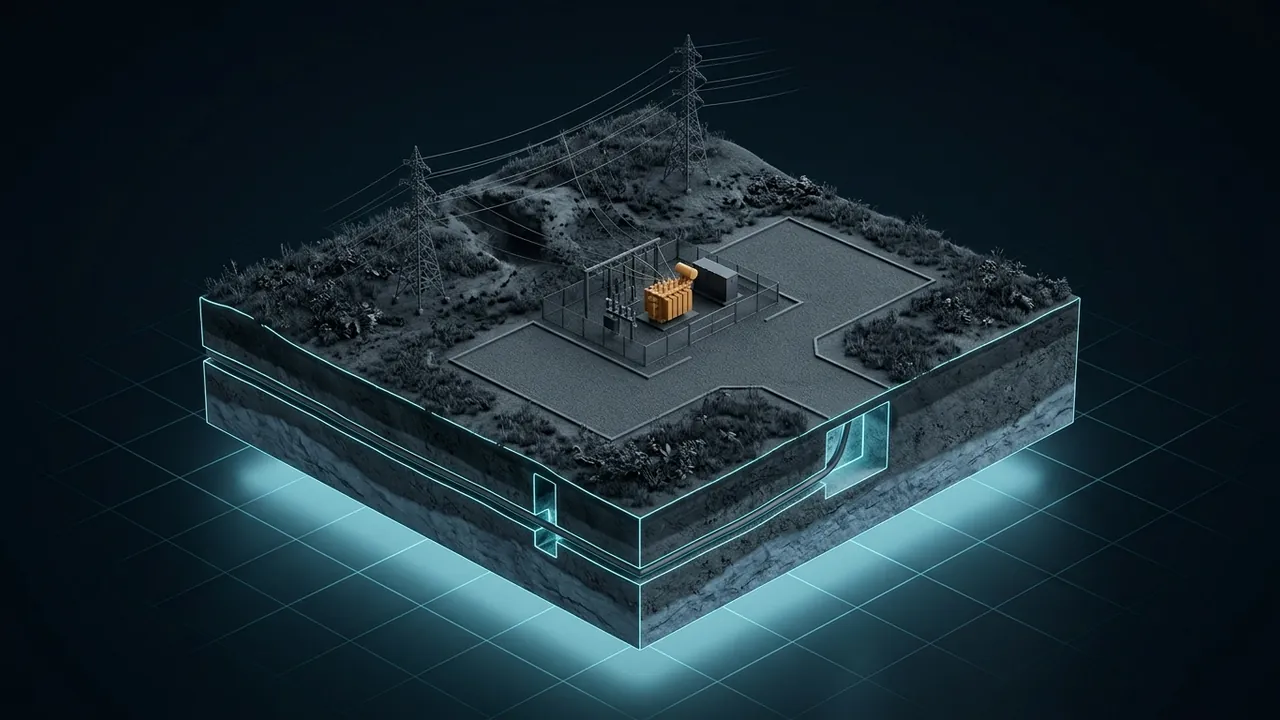
Fifteen years ago, a site selector picking a data center location talked about fiber routes, latency to customers, tax incentives, land prices and the risk of floods or earthquakes. Power mattered, but it was usually assumed: call the utility, sign an agreement, wait a reasonable time. That assumption has broken. Today the first question is how many megawatts a site can actually get, and when. Why does a power-first data center search now lead the industry, and what does that change about where and how campuses get built?
Data center siting now starts with electricity because large campuses need hundreds of megawatts, and in many regions the grid cannot deliver that much power for years. A power-first data center search screens sites by deliverable capacity and energization date before looking at fiber, taxes or land price.
That pushes developers toward places with spare transmission, nearby power plants or natural gas for on-site generation. Industry reports from JLL and CBRE both describe power as the deciding factor in site selection. The change also shifts risk: a cheap, well-connected parcel is worth little if its power arrives in 2032.
What Does Power First Mean?
It means the power answer comes before the real estate answer. In a power-first search, a developer starts with a map of transmission lines, substations, generation and gas pipelines, then looks for land that can be energized at the needed size on the needed schedule. Fiber, water, tax treatment and labor still matter, but they become filters on a short list of power-viable sites instead of the starting point.
It also means being precise about what "power" means. A site that "has power" might have a 13.8 kilovolt (kV) feeder that can serve 5 megawatts (MW) next year, or a 345 kV line next door that could serve 500 MW after a new substation and four years of studies. Those are not the same asset.
How Did Site Selection Work Before?
For most of the 2000s and 2010s, a typical selection checklist looked like this:
- Network: fiber routes, carrier diversity and latency to users.
- Cost: land, construction, power price and taxes.
- Risk: floods, earthquakes, storms and political stability.
- People: a labor pool to build and operate the site.
- Power: confirm the utility can serve the load.
Power was near the bottom because most projects were 5 to 50 MW, and utilities could usually serve that with routine upgrades. The result was clustering in a few strong markets with dense fiber and friendly utilities.
Why Did Power Move to the Front of the Line?
Three forces piled up at once.
Loads grew. Single buildings now draw what whole campuses used to, and campuses are planned in hundreds of megawatts or more. Serving that takes transmission-level connections and sometimes new lines and power plants.
Grid capacity ran short in the favorite markets. According to JLL's 2026 Global Data Center Outlook, as reported by Data Center Frontier, grid interconnection takes four or more years in major markets, and "speed to power" has become the top site-selection criterion. CBRE said the same in plainer words in a September 2026 release on North American data center demand: power is the deciding factor, with primary-market vacancy at just 1.4%.
Equipment got scarce. Even when a utility agrees to serve a load, it needs substations, breakers and large power transformers, and transformer lead times stretched to years. On-site generation runs into the same bottleneck with gas turbines.
What Does a Power-First Site Checklist Cover?

In rough priority order, a power-first screen asks:
- Deliverable capacity: how many MW the utility will commit, in writing, and in what phases.
- Energization date: when each phase can be live, and what upgrades it depends on.
- Voltage and proximity: distance to 138, 230, 345 or 500 kV lines and the substation work required.
- Utility process and tariff: the large-load application steps, deposits, minimum bills and contract terms.
- On-site options: gas pipeline access for bridge or permanent generation, and room for batteries and solar.
- Permits for generation: air permitting for engines or turbines, and local zoning for power equipment.
- Then the classic filters: water, fiber, land, taxes, labor and hazards.
The order matters because the early items are the hardest to change. You can trench new fiber in months. You cannot conjure a transmission line.
What Counts as a Real Power Commitment?
Utilities usually move a large load through stages: an inquiry, a load study, a facilities study that names the upgrades, and finally a signed service agreement with deposits or security. Each stage is more reliable than the one before. A friendly email from an account manager is a stage zero signal. A signed agreement with a scope of upgrades and a target energization date is something you can plan around, though even that date can slip if equipment or permits run late.
How Do You Compare Two Power Offers?
By looking at megawatts over time, not the headline number. Illustrative example of two sites a developer might be offered:
| Site | Year 1 | Year 2 | Year 3 | Year 4 |
|---|---|---|---|---|
| Site A: "up to 600 MW" from a new substation | 0 MW | 0 MW | 0 MW | 300 MW |
| Site B: 150 MW grid now, plus on-site gas | 100 MW | 150 MW | 250 MW | 300 MW |
Add up the MW-years of capacity available over the first four years. Site A delivers 0 + 0 + 0 + 300 = 300 MW-years. Site B delivers 100 + 150 + 250 + 300 = 800 MW-years. If each MW-year of operating capacity earns similar revenue, Site B produces more than two and a half times the revenue in that window, even though Site A has the bigger headline number. Real comparisons add cost, reliability and fuel risk, but the shape of the curve is often decisive.
Does Power First Mean Building Your Own Power Plant?
Not necessarily. Power first is a way of ranking sites, not a single answer. In practice, developers land somewhere on a spectrum:
- Grid only, at a site where the utility can commit capacity on a useful schedule.
- Grid plus bridge power, with temporary on-site generation covering the years before the utility connection is ready.
- Hybrid, with permanent on-site generation running alongside a grid tie.
- Fully off-grid, where the campus makes all its own power.
Moving down the list buys speed and independence, and costs more capital, fuel risk and permitting work. Most developers would still prefer a strong grid connection if they could get one in time. Power-first thinking simply forces them to price the wait honestly, instead of treating the utility date as a formality and discovering the problem after closing on the land.
Where Is Power-First Siting Pushing Development?
Toward wherever power is available sooner. Broadly, that has meant:
- Regions with spare transmission or fast large-load processes, which has drawn interest to parts of Texas, Oklahoma, the Midwest and the Mountain West.
- Sites next to existing power plants, or at retired plant sites where transmission connections already exist.
- Gas country, where pipelines make on-site or bridge generation practical.
- Campuses planned as energy parks, with generation and storage built alongside the data halls.
What Are the Risks of Chasing Power?
A site with great power can still fail on everything else. Remote parcels may lack fiber diversity, skilled labor, housing for construction crews or water for cooling. "Powered land" offers vary widely in quality, so a letter that says power is "available" deserves the same skepticism as any sales claim. Utility large-load tariffs increasingly include minimum payments and long terms, which shift risk to the customer. And on-site generation brings fuel supply, emissions and community questions of its own.
The fix is not to abandon power-first thinking. It is to verify each claim: get capacity and dates in writing, understand the upgrades behind them, and run the classic site filters before committing big money.
The Power-First Data Center Starts With a One-Line, Not a Plat Map
The power-first data center approach exists because electricity became the scarcest input in the business. Loads grew into the hundreds of megawatts, grid connections in the favorite markets stretched to years, and equipment backlogs made both utility and on-site options slower.
Screen your next site list by deliverable megawatts over time first, then apply the traditional filters. A site that can energize in phases soon, with a credible path to full capacity, will usually beat a bigger promise that arrives years later.