Can Data Centers Do Demand Response? – Flexible Load Explained
For years, the data center industry's answer to the grid was simple: we need power, all of it, all the time. Uptime was the product, and data center demand response sounded like a contradiction. That position is softening fast as utilities run out of room and grid operators look for any load that can bend. Can data centers do demand response, and what does flexible load mean for a facility built never to go down?
Yes, data centers can do demand response, though usually less easily than factories or crypto miners, and the amount of flexibility varies widely by facility. A data center can lower its grid draw by pausing or shifting flexible computing jobs, moving work to another site, running on its own batteries or backup generators, or briefly trimming cooling.
Facilities running interruptible batch work have the most room to flex, while those promising constant uptime mostly rely on on-site power. Data center demand response is still early, but grid operators, researchers and regulators increasingly treat it as one of the fastest ways to fit more load on today's grid.
What Is Data Center Demand Response?
Data center demand response means a data center reducing or shifting the power it takes from the grid when the grid operator or utility asks, usually in exchange for payment or lower rates. The data center may keep running at full speed on its own equipment, or it may slow some work down. Either way, the grid sees less load during the stressed hours.
Demand response isn't new. Large industrial customers have done it for decades. A 2025 FERC staff assessment, summarized by the American Public Power Association, counted about 33,272 MW of demand response resources across seven US wholesale markets in 2024, around 6.5% of their combined peak. What's new is asking data centers, historically the least flexible big customers, to join in.
How Can a Data Center Reduce Its Grid Power?
A data center can reduce its grid power in four main ways, and most real programs combine more than one.
Shift or Pause Computing Work
Some computing work doesn't have to happen at a specific minute. Batch processing, data backups, rendering and large model training runs can often be paused, slowed or scheduled around peaks. Operators can cap server power or lower chip frequencies to cut draw without stopping work entirely. This is the cleanest form of flexibility, since nothing extra gets burned.
Move Work to Another Site
Companies with data centers in several regions can sometimes route work away from a stressed grid to one with spare capacity. This depends on software, network capacity and customer contracts, and not every workload can move.
Run on Batteries or Backup Generators
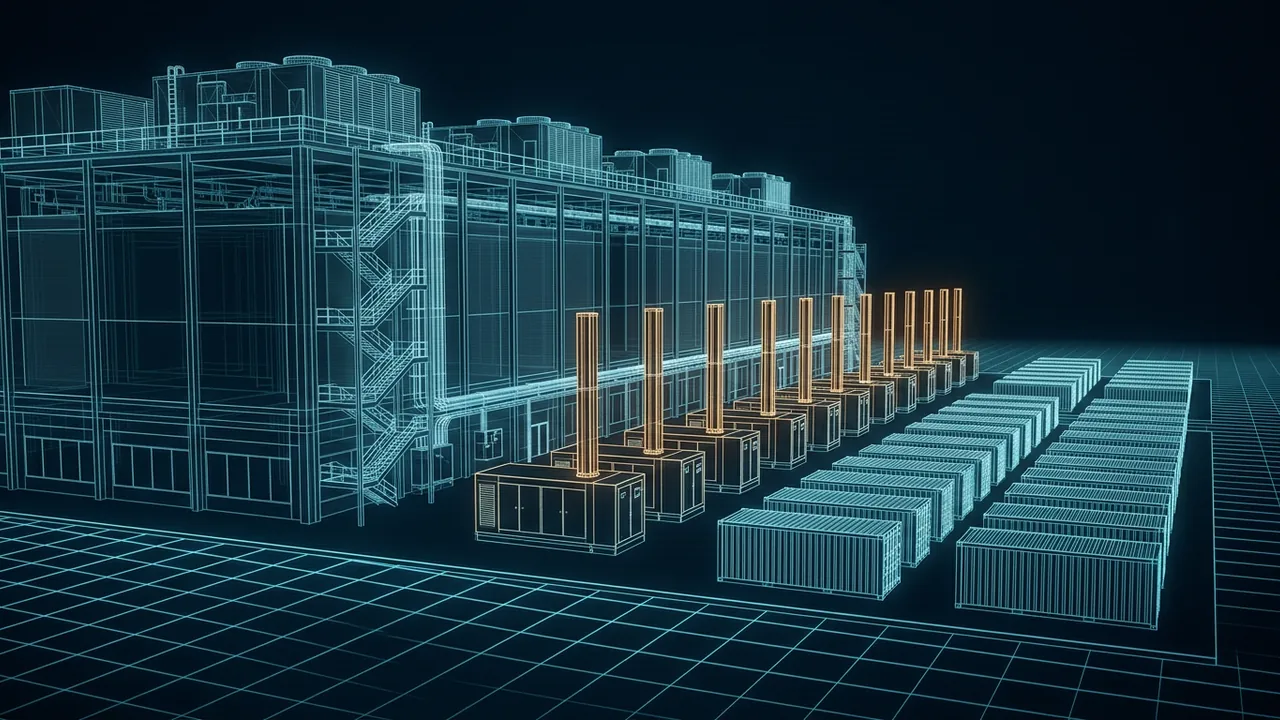
Every serious data center already has backup power. Running on it during grid emergencies takes the load off the grid while keeping servers on. Batteries can cover short events. Generators can run for hours, subject to fuel, maintenance and air permit limits.
Trim Cooling Briefly
Raising temperature setpoints a little or using stored chilled water can shave cooling load for a short window. The savings are modest and limited by equipment temperature ratings.
Why Haven't Data Centers Done Much Demand Response Before?
Data centers mostly avoided demand response because their business model is built on uptime. A colocation operator signs contracts promising its tenants power and cooling every minute of the year. Cutting power to save on electricity costs puts that promise and the revenue behind it at risk.
There were practical barriers too. Backup generators are often permitted only for emergencies, and diesel engines can't run freely for economic reasons. Many enterprise workloads couldn't be paused without a human deciding. Operators also had little incentive, since getting a grid connection was relatively easy until recently.
Crypto miners were the exception. A bitcoin miner can shut down in minutes, lose only that period's revenue and restart. In Texas, miners earned meaningful income from demand response and price-driven curtailment for exactly that reason.
How Much Grid Capacity Could Flexible Data Centers Free Up?
Potentially a lot, according to research from Duke University. As reported by Data Center Dynamics, a February 2025 study from Duke's Nicholas Institute estimated the US grid could absorb up to 76 GW of new load if those loads accepted brief curtailment, and around 100 GW if they curtailed about 0.5% of the time, with average events of roughly two hours.
Here's what 0.5% looks like in hours:
- Hours per year: 8,760
- 0.5% of that: 8,760 × 0.005 = 43.8 hours
- At about two hours per event, that's roughly 22 events a year
The logic is that grids are built for a handful of peak hours. Most of the year, there's spare capacity. A load willing to step back during those few peaks can fit on a grid that couldn't handle it as a constant load. Whether real data centers accept those terms is a business decision, not a physics problem.
How Do Data Centers Get Paid for Flexibility?
Data centers can earn value from flexibility through several channels, depending on the region:
- Utility demand response programs that pay for reductions during called events.
- Wholesale energy markets, where cutting use during price spikes avoids costly power.
- A capacity market, where demand response can bid against power plants to be available during peaks.
- Ancillary services, such as fast reserves, in markets like ERCOT.
- Lower transmission charges, where costs are based on usage at system peaks.
- Faster interconnection, through non-firm service or flexible connection agreements.
That last one may matter most. For a developer facing a multi-year wait, agreeing to be curtailed a few dozen hours a year in exchange for connecting sooner can be worth more than any program payment.
Program payments still add up, though. As a made-up round number, a program paying $50 per kW-year for 20 MW of committed reduction would pay 20,000 kW × $50 = $1,000,000 a year. Real prices vary widely by market and year, and capacity prices in some regions have swung by close to a factor of ten from one auction to the next, so use your own utility's current numbers.
What Does a Data Center Need to Join a Demand Response Program?
A data center needs metering, controls and a tested plan before it can deliver demand response reliably. The details vary by program, but the checklist is fairly consistent:
- Interval metering that records grid draw in short increments, so the reduction can be measured.
- A baseline, the agreed estimate of what the site would have used without the event, which sets how much credit it earns.
- Controls that can start backup power, cap server power or shift jobs automatically when a signal arrives.
- Communications and telemetry to receive dispatch signals and report performance, sometimes in real time.
- Test events to prove the site can actually deliver, before it counts on the payments.
The hardest part is usually internal. Facilities, IT and the commercial team all need to agree on which loads can flex, for how long and at what price. A clear written playbook avoids an argument in the middle of a grid emergency.
Can Backup Generators Be Used for Demand Response?
Sometimes, within limits set by air rules and permits. In May 2025, the US Environmental Protection Agency issued a clarification that certain emergency engines may run up to 50 hours per year for non-emergency demand response under specific conditions. State air permits often add their own hour limits and conditions.
Running diesel generators also has costs: fuel, wear, maintenance, emissions and neighbor relations. Gas engines and batteries tend to be easier to use for routine flexibility. Before you enroll backup engines in any program, check federal engine rules, your air permit and your fuel contracts with qualified environmental counsel.
What Are the Risks of Data Center Demand Response?
The main risks are reliability, contracts and performance. If backup equipment fails to start during an event, the facility could lose power or face penalties. Tenant contracts may forbid interruptions. Programs penalize customers who don't deliver promised reductions.
There's also a grid-side risk. If many large loads switch off or onto backup at once, the sudden drop can disturb the grid itself, so operators want curtailment to be coordinated and controlled, not abrupt.
Data Center Demand Response Turns Flexibility Into an Asset
So, can data centers do demand response? They can, using smarter scheduling, on-site batteries and generators, and flexible connection deals. The facilities with interruptible workloads have the most room, while uptime-focused colocation sites will lean mostly on on-site power.
The bigger shift is in how flexibility gets valued. In a world of crowded grids and long queues, a data center that can step back a few dozen hours a year may connect years sooner. That makes data center demand response less of a sacrifice and more of a strategy.
A good first step costs nothing: sit facilities, IT and sales in one room and write down which loads could flex, for how many hours, and what the backup plan is. Then size batteries and generators with that list in hand, and check your air permit hours before you enroll in anything. Program rules vary by utility and market, so get the local details in writing.