What Is LoRaWAN? – Low-Power Networks for Remote Sensors
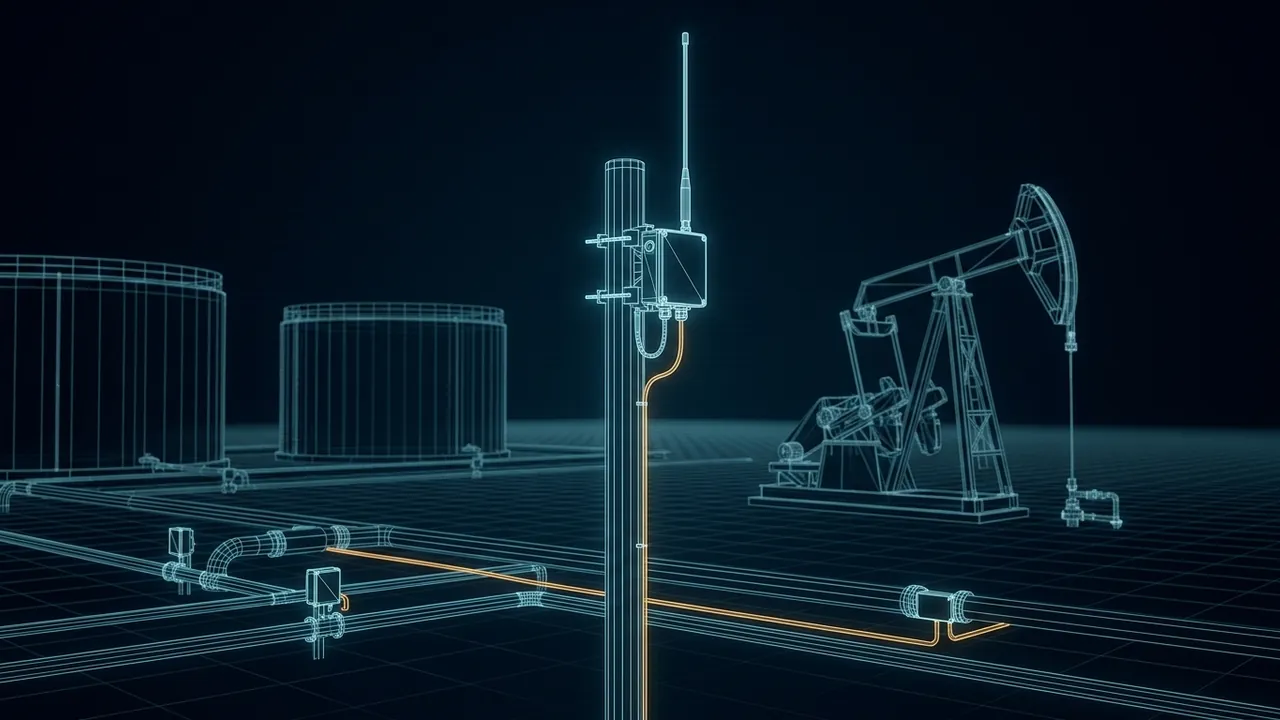
Forty storage tanks, a dozen pressure points and a few generator fuel tanks, all scattered across several square miles of lease. Each one only needs to send a number every few minutes. Running power and cable to all of them would cost a fortune, and a cellular modem at every point would drain batteries in days and add a monthly bill each. LoRaWAN was built for exactly this kind of job. What is LoRaWAN, and where does it fit at a remote site?
LoRaWAN (Long Range Wide Area Network) is a low-power wireless network standard that lets small battery-powered sensors send short messages over distances of miles to a gateway, which then forwards the data to a server over cellular, satellite or Ethernet.
It runs in unlicensed radio bands (902 to 928 MHz in the US), so a self-run network has no license or per-device airtime fee. The trade-off is very low data rates and small messages, which suit readings like tank level, pressure, temperature and fuel level, not video or fast control. A sensor reporting every few minutes can run for years on one battery.
How Does LoRaWAN Work?
LoRaWAN uses a "star of stars" layout. Sensors talk to gateways, and gateways talk to a central network server. There is no mesh and no sensor-to-sensor relaying, which keeps the sensors simple and frugal.
- End devices (sensors) wake up, take a reading, transmit a short packet and go back to sleep.
- Gateways receive every packet they can hear from any sensor in range and pass it along, often over a cellular or satellite link.
- The network server removes duplicate copies heard by multiple gateways, checks security and manages data rates.
- The application server decodes the reading and hands it to SCADA, a historian or a dashboard.
"LoRa" itself is the radio technique underneath, a form of chirp spread spectrum that can pull weak signals out of noise. LoRaWAN is the network protocol on top, maintained by the LoRa Alliance. According to the LoRa Alliance's overview, LoRaWAN can reach up to 15 km in rural areas and support battery life of 10 years or more.
What Are LoRaWAN's Device Classes?
LoRaWAN defines three classes that trade battery life for how quickly a device can receive a command:
- Class A: the device listens briefly only right after it transmits. Lowest power, and the most common for sensors.
- Class B: adds scheduled listening windows, so the network can reach the device at known times.
- Class C: listens almost all the time. Fast to reach, but suited to devices with line power.
For monitoring tanks, pressures and fuel levels, Class A is the usual choice. If you need to open a valve on command within a second, LoRaWAN is the wrong tool.
How Long Do LoRaWAN Sensor Batteries Last?
Years, if the reporting rate is sensible. Here is an illustrative battery estimate with example values. Real devices vary, so use the manufacturer's numbers.
- Transmit: 40 mA for 0.2 seconds, 96 times a day (every 15 minutes) = 768 mA-seconds, or about 0.21 mAh per day
- Sleep: 5 microamps × 24 hours = 0.12 mAh per day
- Sensor reading and processing: about 0.1 mAh per day
- Total: about 0.43 mAh per day, or 157 mAh per year
- Battery: a lithium AA-size cell of about 2,400 mAh lasts 2,400 ÷ 157 = about 15 years on paper
Real life cuts that number, because of self-discharge, cold weather, retransmissions and slower data rates at long range. Planning for something closer to half the paper figure is a sensible habit. Report every minute instead of every 15 and the battery life drops sharply.
LoRaWAN vs Cellular IoT vs SCADA Radio
LoRaWAN is one of several low-power wide-area network (LPWAN) options. Here is how it compares with cellular IoT, such as LTE-M and NB-IoT, and traditional SCADA radio.
| Factor | LoRaWAN | Cellular IoT (LTE-M, NB-IoT) | SCADA radio |
|---|---|---|---|
| Spectrum | Unlicensed | Carrier's licensed bands | Licensed or unlicensed |
| Coverage | Where you put gateways | Where the carrier builds | Where you build |
| Data per message | Tens to a couple hundred bytes | More, with higher rates | Moderate |
| Battery life | Years | Years for low rates | Usually solar powered |
| Recurring cost | Low if self-run | Per-device plan | Low |
| Control commands | Slow | Moderate | Good |
Most of the time, LoRaWAN works alongside an RTU and SCADA radio rather than replacing them. The RTU handles control at the main site. LoRaWAN picks up the scattered, low-value measurements that were never worth wiring.
What Does It Take to Set Up a LoRaWAN Network?
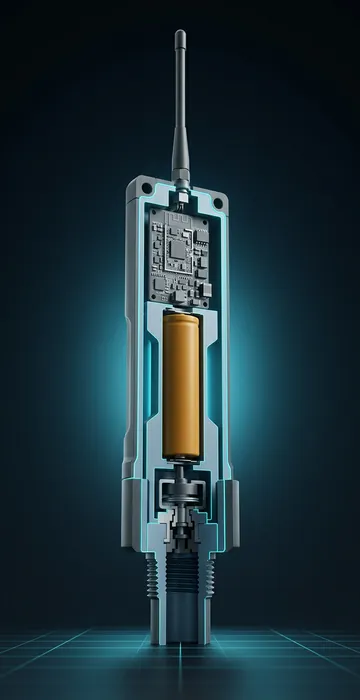
Less than most wireless projects, which is part of the appeal. A small pilot can be running in days. The main decisions are who runs the network and where the gateways go.
- Network server: run your own, use a hosted service, or join a public network where one covers your area. Running your own gives full control. Hosted saves work.
- Gateway placement: height is everything. A gateway on a tall pole, tank or existing radio tower with a clear view across the field will hear far more sensors than one mounted low on a building.
- Backhaul: the gateway needs a path to the server, usually cellular, satellite or an existing site network.
- Power: a gateway draws only a few watts, so a small solar panel and battery can run it at a site with no utility power.
- Sensors: confirm each one supports your regional band and the LoRaWAN version your network server uses.
Start with a site survey. Walk or drive the area with a test sensor and see where the gateway loses it. Coverage claims are a starting point, and terrain, tanks and trees always have the final say.
Is LoRaWAN Secure?
The standard includes solid security, but it has to be set up right. LoRaWAN encrypts traffic with AES-128 and uses two separate keys: one secures the link between device and network server, and another encrypts the application data end to end. That means a gateway can forward packets without being able to read the readings inside.
The weak points are usually operational. Keys get shared in spreadsheets, devices ship with default settings, and network servers end up exposed to the internet. Treat key management with the same care as SCADA passwords.
What Are LoRaWAN's Limits?
It is a narrow tool, and it works best when you respect its limits:
- Low data rates, from a few hundred bits per second up to tens of kilobits per second.
- Small messages, so no images, audio or firmware-heavy traffic.
- Limited downlink capacity, since gateways can only send so many replies.
- Unlicensed spectrum, so other users can add interference.
- Not suited to safety-critical shutdowns or tight control loops.
There is also the question of where the data gets processed. A gateway sitting on a cellular link can forward raw readings to the cloud or feed a local edge computer that acts on them first. Our guide to edge vs cloud processing walks through that choice.
LoRaWAN Is the Cheap Way to Hear From Everything Else
LoRaWAN, in one line, is a long-range, low-power network for sensors that need to send a small number every few minutes and run for years on a battery. Gateways cover miles, unlicensed spectrum keeps costs low, and AES encryption protects the data.
It will not replace your RTUs, radios or cellular links for control and video. It fills the gap below them, covering the tanks, gauges and fuel levels that never justified their own power and modem.
Ask your pumpers which readings they still drive out to check. If each one only needs a number every few minutes, one gateway and a handful of sensors make a cheap pilot, and a season of data will tell you whether to expand.