How Much Fuel Does a Solar-Diesel Hybrid Save at a Remote Site?
How many times a month does a fuel truck make the long drive out to your site? For remote telecom towers, wellsite controls, mining camps and small off-grid compute sites, that question drives a big chunk of the operating budget. Diesel itself costs money, hauling it costs more, and every engine hour adds maintenance. Adding solar panels sounds like an obvious fix, but the savings depend heavily on how the system is designed. How much fuel does a solar-diesel hybrid actually save at a remote site?
A well-designed solar diesel hybrid with batteries typically saves well over half the diesel a remote site would otherwise burn, while panels added without storage usually save much less, often in the 10% to 20% range. The difference comes from how diesel generators work. Without a battery, the generator has to keep running around the clock, and solar can only trim its daytime output down to a safe minimum load.
With a battery, the generator can shut off entirely for long stretches and run only at efficient loads to recharge. Exact savings depend on sunshine, load shape, generator size and controls, so a site-specific model is worth doing before buying hardware.
What Is a Solar Diesel Hybrid System?
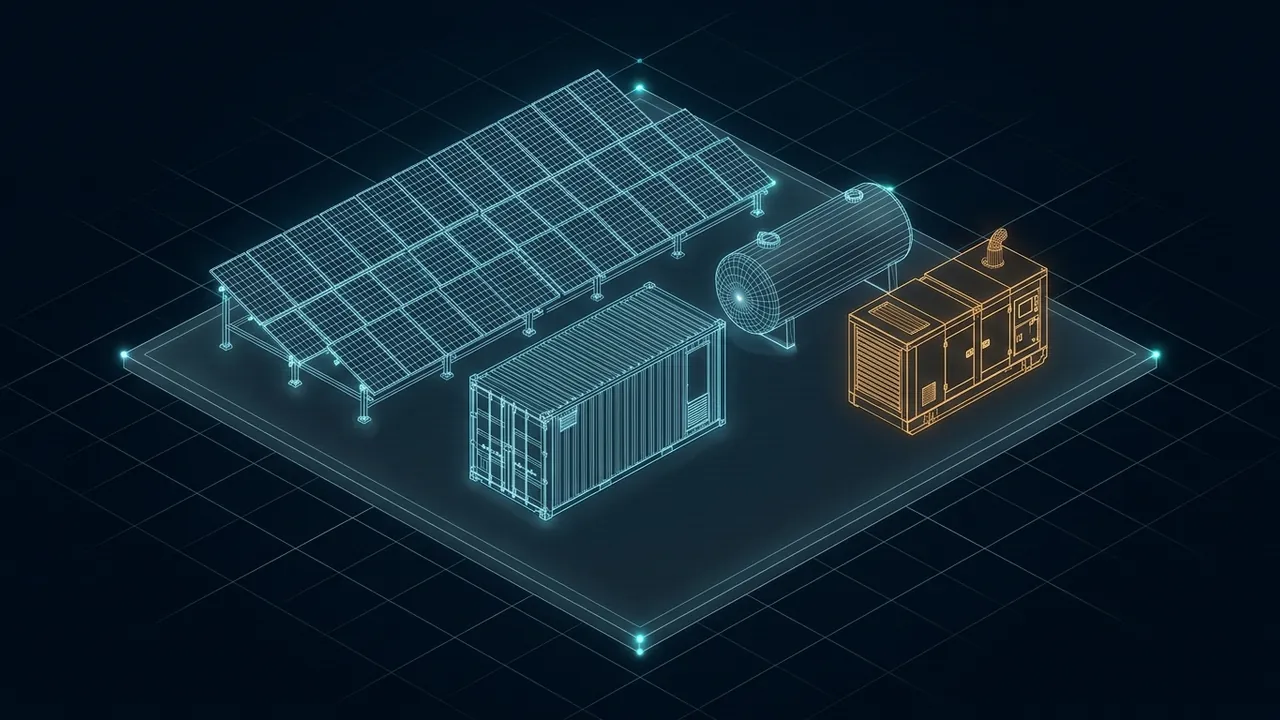
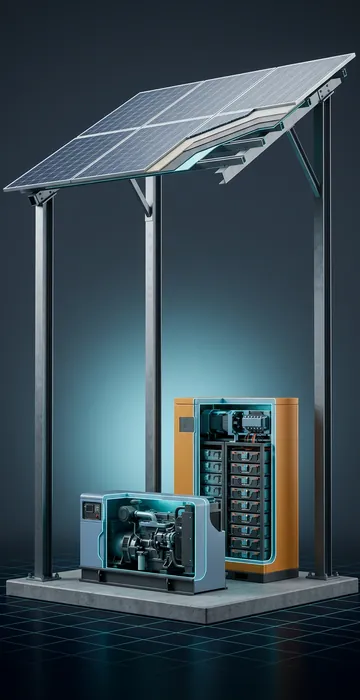
A solar diesel hybrid is a power system that combines a diesel generator with solar panels, and usually a battery, under one controller. It's the most common way to cut fuel at sites that can't connect to the grid.
- Diesel generator: The dependable backbone that runs at night, in bad weather and during heavy loads.
- Solar photovoltaic (PV) array: Supplies free energy during daylight.
- Battery: Stores midday surplus and lets the generator stay off.
- Inverters and controller: Decide which source serves the load and when the generator starts or stops.
Designs range from "fuel saver" systems that simply add panels to a running generator, to "solar-first" systems where the battery and panels carry the site most of the time and the generator acts as backup.
Why Don't Solar Panels Alone Save More Fuel?
Solar panels alone don't save more fuel because the generator can't shut off while it's the only source holding the system up, and it can't run at very low load without problems. Diesel engines don't like light loading. Running below roughly 30% of rated output for long periods can cause "wet stacking," where unburned fuel and soot build up in the exhaust, and fuel efficiency gets worse anyway.
So in a panels-only system, solar can only cover the gap between the load and the generator's minimum. If a site draws 40 kW and the generator's floor is 18 kW, solar can carry at most 22 kW at any moment. A bigger array just gets curtailed at midday. And at night, solar does nothing at all.
How Much Fuel Does a Solar Diesel Hybrid Save? A Worked Model
Here's a simple model with stated assumptions, so you can follow the math and adjust it for your own site. It isn't data from a real project.
- Load: a steady 40 kW average, so 40 × 8,760 = 350,400 kWh a year.
- Generator: a 60 kW diesel genset with a 30% minimum load (18 kW).
- Fuel use: about 0.075 gallons per kWh at normal load, worse at light load and slightly better near full load, based on typical published fuel curves for small diesel gensets.
- Solar yield: 1,600 kWh per kW of panels per year, typical of a sunny site.
Three cases follow:
- Diesel only: 350,400 kWh × 0.075 = about 26,300 gallons a year.
- Add 60 kW of PV, no battery: The array could make 60 × 1,600 = 96,000 kWh, but the minimum load limit means only about 60,000 kWh is usable. The generator still makes about 290,400 kWh, now often at light load, so assume 0.078 gallons per kWh: roughly 22,700 gallons, about 14% less.
- Add 200 kW of PV and 500 kWh of batteries: Solar now supplies about 65% of the load after curtailment and battery losses. The generator makes the other 35%, about 122,600 kWh, mostly at efficient loads: 122,600 × 0.07 ≈ 8,600 gallons, about 67% less than diesel only.
The chart below compares the three cases.
Gallons per year in three design cases
Model: 40 kW steady load, 60 kW genset with 30% minimum load, assumed fuel rates of 0.07 to 0.078 gal/kWh, PV yield of 1,600 kWh per kW per year, assumed usable solar of 60,000 kWh (case 2) and 65% solar fraction (case 3).
View the data
| Diesel use | |
|---|---|
| Diesel only | 26,300 gal |
| Diesel + 60 kW PV | 22,700 gal |
| Diesel + 200 kW PV + 500 kWh battery | 8,600 gal |
Notice the jump between cases two and three. The battery is what turns solar from a modest fuel trimmer into the main energy source, because it lets the generator turn off.
What Are the Savings Worth in Dollars and Emissions?
The savings are worth more than the fuel price alone suggests, because remote fuel is expensive to deliver and engines cost money to run. Continuing the illustrative model with diesel delivered at $4.50 per gallon:
- Diesel only: 26,300 × $4.50 ≈ $118,000 a year in fuel.
- Solar plus battery: 8,600 × $4.50 ≈ $38,700 a year.
- Fuel saved: about 17,700 gallons, or roughly $79,000 a year.
- Carbon dioxide avoided: diesel emits about 10.2 kg of CO2 per gallon, so 17,700 × 10.2 ≈ 180 metric tons a year.
Generator run hours fall too, from about 8,760 a year to perhaps a third of that, which stretches oil changes, overhauls and the engine's life. Fewer fuel deliveries also mean fewer trips down rough roads in bad weather, a safety benefit that's hard to price but easy to appreciate.
Do Controls Really Change the Savings?
Yes, controls can change the savings dramatically, even with the same hardware. A controller decides when to start the generator, how hard to run it and how much battery reserve to keep. Poor settings can leave the generator running when the battery could carry the load, or let solar get curtailed when the battery has room.
The National Renewable Energy Laboratory's REopt case study of Alcatraz Island shows how big this can be. The island already had solar, batteries and diesel generators, and NREL's analysis found that better PV and battery dispatch could cut diesel use by about 50%, roughly 15,000 gallons a year, while reducing wasted solar from 30% to 4%. No new panels required; just smarter operation.
Which Remote Sites Benefit Most From a Hybrid?
The sites that benefit most are the ones that pay the most per gallon and run their generators the most hours. A steady load in a sunny place with an expensive fuel haul is the sweet spot.
- Telecom towers: Small, steady loads far from the grid, often with diesel stocks that last only a day or two between deliveries.
- Oil and gas field sites: Controls, communications, chemical pumps and small compute loads at leases without power lines.
- Mining and construction camps: Larger loads, long fuel hauls and multiyear operations that give hardware time to pay back.
- Islands and isolated communities: Fuel arrives by barge or plane, so every gallon saved is worth a lot.
The weaker cases are short-term sites that move every few months, loads that run mostly at night, and cloudy northern locations with long winters. Solar still helps there, but the payback stretches out, and portable or skid-mounted designs that can move with the job make more sense than fixed arrays.
How Big Should the Solar and Battery Be?
The solar and battery should be sized to the load, the local sunshine and how much fuel you want to displace, with the battery sized to carry at least the evening and night. A few rules of thumb help:
- Start with real load data, ideally a year of 15-minute or hourly readings.
- Use the worst month's sunshine, not the annual average, to check winter performance.
- Size the battery to cover the hours between sunset and the next morning's solar for most days.
- Keep the generator big enough to carry the full load and recharge the battery at the same time.
- Expect diminishing returns as solar fraction climbs past about 70% to 80%.
That last point is where hybrids hit a wall. Covering the final stretch of cloudy days with batteries alone needs storage measured in days, not hours, which is the job of long duration energy storage. For most remote sites, it's cheaper to let the generator handle those days.
Solar Diesel Hybrid Savings Come From Turning the Generator Off
So how much fuel does a solar diesel hybrid save? In our model, panels alone cut diesel use by about 14%, while panels plus a battery cut it by about two-thirds. The lesson carries over to real sites: savings depend less on how many panels you install and more on whether the generator can shut off.
The battery and the controller are the heroes of this story. They let solar carry the site through the day and the evening, and they let the generator run only when it can run efficiently.
If you manage a remote site, pull a year of fuel delivery records and load data, then model a solar-plus-storage case before choosing hardware. Free tools such as NREL's REopt can help, and the fuel receipts will tell you quickly whether the payback is worth chasing.