Oilfield Power Generation – How Remote Pads Get Electricity
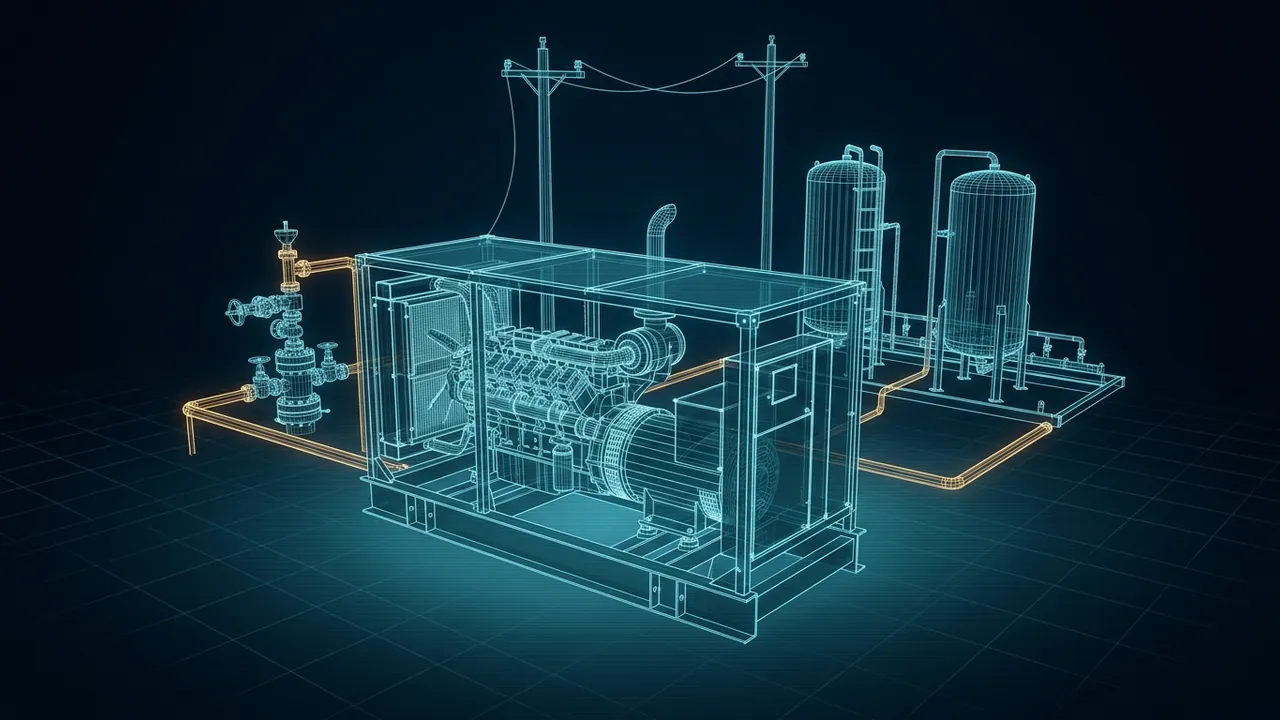
Wellpads get built where the oil is, not where the power lines are, and the nearest usable gas is often sitting in the separator a few feet away. Pumps, compressors and controls all need power, and the choice between a utility line, a generator burning field gas and a few solar panels comes down to load size, distance and gas supply. Pick wrong and you either pay for a line you did not need or babysit a generator that keeps tripping. How does oilfield power generation work on a remote pad, and how do you choose the right setup?
Remote oil and gas pads get electricity in three main ways: a utility line extension, on-site generators (usually natural gas engines burning field gas, sometimes diesel), or solar panels with batteries for small loads. Utility power wins when a line is close and the pad will produce for years.
Gas generators win when the grid is far away, loads are large, such as electric submersible pumps and compressors, and gas is available on site. Solar and batteries handle small, steady loads like controllers, radios and chemical pumps. Many fields mix all three, and some operators build small power networks that serve several pads from one generation site.
What Uses Electricity on an Oil and Gas Pad?
The big loads are motors. The small loads are electronics. Everything else falls in between.
- Artificial lift: rod pumping units (motors often in the tens of horsepower) and electric submersible pumps (ESPs), which can run to hundreds of horsepower each.
- Compression: gas lift compressors, vapor recovery units and wellsite boosters.
- Transfer and injection: water transfer pumps, saltwater disposal pumps and chemical injection pumps.
- Controls and communications: RTUs, flow computers, radios, cameras and gas detectors.
- Site loads: lighting, heat tracing, enclosure heaters and sometimes office trailers.
Some equipment runs on gas directly, such as heater-treaters and gas engine-driven compressors, which keeps them off the electrical bill. But the trend on many pads has been toward electric motors, because they are simpler to maintain and easier to control remotely.
When Does a Utility Line Make Sense?
A utility line makes sense when it is close, the load is large and steady, and the field will produce long enough to justify the extension. Utility power needs no fuel, little on-site maintenance and no air permit for generators.
The catch is cost and time. Rural electric cooperatives and utilities often ask the customer to pay for line extensions to serve new load, and building miles of line, plus any substation upgrades, takes months or longer. In a new development area, wells may come online long before the power does. That gap is where generators earn their keep.
How Do Field-Gas Generators Work on a Pad?
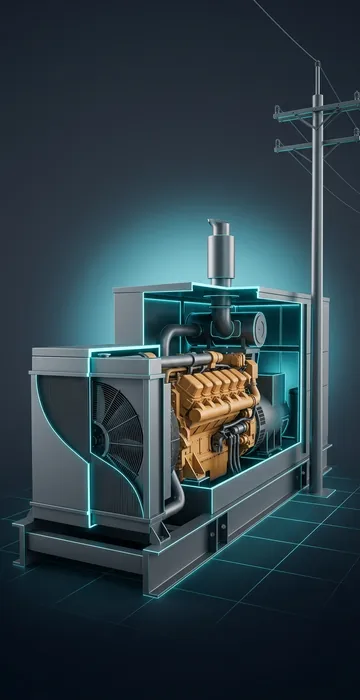
A gas generator set is a reciprocating engine driving an alternator, packaged on a skid with controls and cooling. On a pad, it burns gas taken from the separator or a sales line, often after a fuel-gas conditioning skid removes liquids and heavy hydrocarbons.
Gas engines are a mature technology. The EPA's Catalog of CHP Technologies lists reciprocating engines at roughly 27 to 41 percent electric efficiency (on a higher heating value basis) across sizes from a few kilowatts to about 10 MW, with availability of 96 to 98 percent. That availability number assumes good maintenance, which on a remote pad means someone actually shows up for oil changes.
Why Gas Quality Matters
Raw field gas is not pipeline gas. It can be rich in heavier hydrocarbons, wet, or sour with hydrogen sulfide (H2S). Rich gas lowers knock resistance, which can force an engine to derate, and liquids and H2S damage engines over time. A conditioning skid and an engine rated for the gas composition are the difference between a reliable unit and a weekly service call.
How Much Gas Does a Wellsite Generator Burn?
Here is a worked example for a pad with four ESPs. Example inputs: four 150 hp ESP motors, 90% combined motor and drive efficiency, 50 kW of other loads, engine efficiency of 34% (higher heating value), and field gas at 1,100 Btu per standard cubic foot.
- ESP shaft power: 4 × 150 hp × 0.746 kW/hp = 448 kW.
- Electrical input: 448 ÷ 0.90 = about 498 kW, call it 500 kW.
- Total pad load: 500 + 50 = 550 kW.
- Heat rate: 3,412 Btu/kWh ÷ 0.34 = about 10,000 Btu/kWh.
- Fuel per hour: 550 kW × 10,000 Btu/kWh = 5.5 MMBtu per hour.
- Fuel per day: 5.5 × 24 = 132 MMBtu per day.
- Gas volume: 132 MMBtu ÷ 1.1 MMBtu per Mcf = 120 Mcf per day.
For a pad producing several hundred Mcf a day or more, that is a modest share of the gas. Whether gas burned on the lease carries royalty depends on the lease's free-use language and state law, so check with counsel before assuming it is free.
How Do You Size Generators for Pumps and Compressors?
Size for starting, not just running. A large motor started across the line can draw roughly six times its running current for a few seconds, and a generator that cannot supply that surge will sag in voltage and trip. Variable frequency drives (VFDs) and soft starters ramp motors up gently, which lets you use smaller generators.
Redundancy matters too. In the example above, two 400 kW units in parallel carry the 550 kW load with headroom, but if one trips, the other cannot carry it alone. Three 400 kW units let one sit down for service while the other two carry the pad. Generators running all the time should carry a prime power rating, not a standby rating, since standby ratings assume limited annual hours.
Where Does Solar Fit in Oilfield Power Generation?
Solar fits the small, steady loads that run day and night: RTUs, radios, gas detectors, cathodic protection and chemical injection pumps. Suppliers such as SunWize build solar-plus-battery systems for upstream oil and gas that power exactly these loads, including designs for hazardous locations.
Solar does not make sense for an ESP or a compressor on its own. Those loads run around the clock at hundreds of kilowatts, which would need a huge array and a battery bank sized for every night and every cloudy week. For big loads, solar is at most a fuel saver alongside generators.
How Do the Options Compare?
| Option | Best for | Strengths | Watch outs |
|---|---|---|---|
| Utility line | Long-life fields near existing lines | No fuel, low site maintenance | Extension cost, months of lead time |
| Field-gas generators | Large loads far from the grid | Uses gas already on site, fast to deploy | Gas quality, maintenance, air permits |
| Diesel generators | Short-term needs, drilling and completions | Simple, widely available rentals | Fuel delivery and fuel cost |
| Solar and batteries | Controls, radios, small pumps | No fuel, very low maintenance | Not practical for large motor loads |
What Else Should Operators Plan For?
A few items catch teams by surprise. Stationary engines fall under federal and state air rules, so check permit needs with your state regulator before the units arrive. Electrical equipment near wellheads and tanks must meet hazardous area classification rules, which set where and how it can be installed. All work on generators, switchgear and energized lines belongs to qualified electricians and technicians.
New loads are showing up on leases too. Some operators host bitcoin mining or other computing on stranded gas, turning a gas problem into a power customer. If those boxes are new to you, our guide that answers what is a data center covers the power, cooling and connectivity basics behind them.
Matching Oilfield Power Generation to the Pad
Oilfield power generation is a matching exercise. Utility lines suit long-life fields close to the grid. Gas generators suit large loads far from it, using gas the pad already produces. Solar and batteries handle the small electronics that keep the site talking.
Start with a load list that includes motor starting, then check the distance to power, the gas volume and quality, and how long the pad will produce. Those four facts will point you to the right mix, and they will make the conversation with your utility, generator vendor or regulator much shorter.