What Is a Data Center? – Power, Cooling and Connectivity Basics
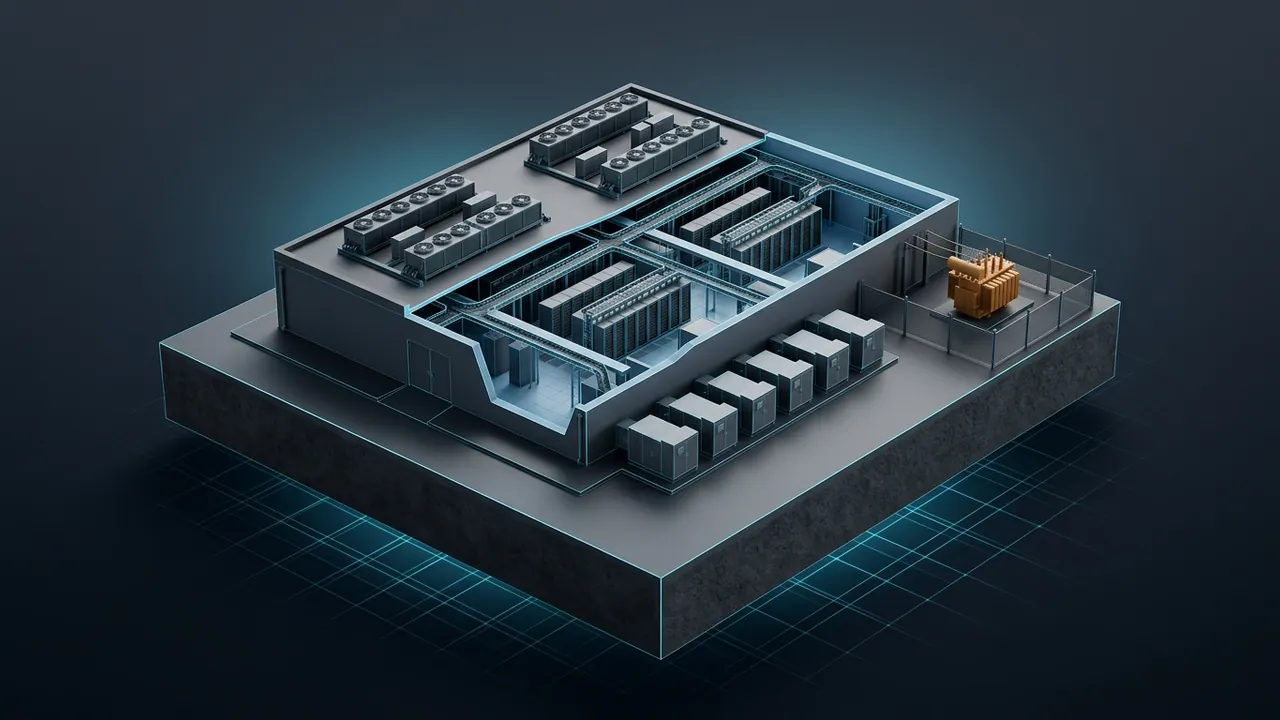
From the highway, most data centers look like oversized warehouses with no windows. The giveaways are the substation next door, the row of generators along one wall and the cooling units lined up on the roof. Inside, the building has one job: keep thousands of computers powered, cool, connected and safe every hour of the year. That job shapes everything about how these places are designed and where they get built. What is a data center, really, and how do its power, cooling and connectivity systems fit together?
A data center is a building, or part of one, designed to house computer servers, storage and networking equipment along with the power, cooling, connectivity and security systems that keep them running continuously. Electricity arrives from the utility, passes through transformers and switchgear, and feeds uninterruptible power supplies (UPS) that bridge the seconds until backup generators start.
Data center cooling systems remove the heat that every server gives off, since nearly all the electricity used ends up as heat. Fiber optic links tie the building to networks and the internet. Data centers range from a single room in an office to campuses drawing hundreds of megawatts.
What Is a Data Center Used For?
It is used to run and store the digital services people and businesses depend on. Email, websites, banking, streaming, payroll systems, online stores and cloud storage all live on servers in a data center somewhere.
Different owners use them in different ways:
- Enterprise data centers belong to one company and run its own systems.
- Colocation facilities rent space, power and cooling to many customers, who bring their own servers.
- Cloud and hyperscale data centers belong to large providers who rent computing as a service.
- Edge data centers are smaller sites placed close to users or to remote operations, such as a compressor station or cell tower.
What Is Inside a Data Center?
Think of it as two kinds of space. The "white space" holds the IT equipment. The "gray space" holds everything that supports it.
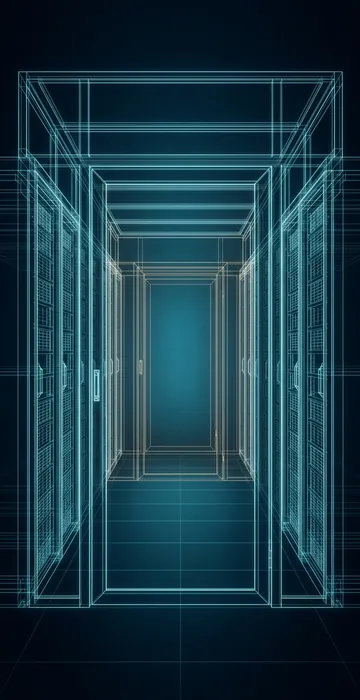
In the white space, servers sit in rows of metal racks, usually about 7 feet tall. Racks are arranged in aisles so cool air enters the front of each server and hot air leaves the back. Storage arrays and network switches sit in the same rows, linked by overhead or underfloor cable trays.
The gray space holds electrical rooms, UPS systems and batteries, switchgear, cooling plant, fire suppression and the generator yard. In many buildings the gray space is as big as the white space, which surprises people seeing a floor plan for the first time.
How Big Is a Data Center?
Anywhere from a closet to a campus. Size is usually described by power, not floor area, because power is what limits how many servers fit. A rough ladder looks like this:
- Server closet or small room: a few racks, often tens of kilowatts, tucked inside an office or plant.
- Edge or modular site: one or a few containers or small rooms, from tens of kilowatts to a few megawatts.
- Enterprise or colocation building: several megawatts to tens of megawatts of IT load.
- Large campus: several buildings sharing a substation, reaching hundreds of megawatts.
Floor area tells you less than it used to. Racks keep getting denser, so two buildings with the same square footage can differ several times over in power and cooling needs. When a developer says "a 30 MW data center," they almost always mean the IT load the building is designed to support, not the total draw at the meter.
How Does Power Flow Through a Data Center?
Power takes a predictable path from the grid to each server, with backup at every key step. Here is the typical chain:
- Utility feed: high-voltage lines arrive at an on-site or nearby substation.
- Transformers: voltage steps down to medium voltage, then to the low voltage used inside the building.
- Switchgear: breakers and protective relays route power and isolate faults.
- UPS: batteries or flywheels carry the load instantly if utility power drops, and clean up voltage problems.
- Power distribution units (PDUs): power is split into circuits for each row.
- Rack power strips: power reaches each server's power supply.
Backup generators connect through automatic transfer switches. When utility power fails, the UPS carries the load for seconds to minutes while the generators start and pick up the building. Facilities designed for high reliability duplicate parts of this chain so one failure, or one maintenance outage, does not drop the servers.
How Much Electricity Does a Data Center Use?
A lot, for its size. The U.S. Department of Energy notes that data centers use 10 to 50 times the energy per square foot of a typical office building. A small server room might draw tens of kilowatts. A large facility can draw tens or hundreds of megawatts, around the clock.
The math behind those numbers, from a single server up to national totals, is covered in our guide to data center power usage. Put simply, the IT load sets the baseline, and cooling and power losses add to it.
How Is a Data Center Cooled?
Nearly all the electricity a server uses ends up as heat, so cooling is the second biggest job in the building. The basic idea is to move heat from the chips to the room air or a liquid, then out of the building.
In a typical chilled-water design, heat travels from the servers to room air, from the air to chilled water in a coil, and from the water to the outdoors through chillers and cooling towers. Common pieces include:
- Computer room air handlers (CRAH) or air conditioners (CRAC) that cool air in the data hall.
- Hot aisle or cold aisle containment, which stops hot and cold air from mixing.
- Chillers and cooling towers that reject heat outdoors, or dry coolers that use no water.
- Economizers that use cool outside air or water when the weather allows, cutting energy use.
- Liquid cooling, piped directly to chips or racks, for very dense equipment.
The efficiency of all that support equipment is measured by power usage effectiveness, or PUE: total facility energy divided by IT energy. A PUE of 1.5 means half a watt of overhead for every watt of computing. Lower is better, and the best modern sites get well under that.
How Do Data Centers Connect to the Internet?
Through fiber optic cables, ideally several of them, entering the building by different routes. If a backhoe cuts one, traffic shifts to another.
Inside, carriers and customers meet in a "meet-me room," where cross-connect cables link one network to another. Colocation facilities with many carriers are valuable precisely because customers can connect to many networks inside one building. Distance matters too: the farther a data center sits from its users, the longer each round trip takes, which is why some workloads stay near cities while others can go almost anywhere with power and fiber.
How Do Data Centers Stay Up When Things Break?
With redundancy, procedures and testing. Designers describe redundancy with shorthand:
| Design | Meaning | Example |
|---|---|---|
| N | Exactly enough capacity, no spare | 4 generators for a 4-generator load |
| N+1 | One spare unit beyond the need | 5 generators for a 4-generator load |
| 2N | A full duplicate system | Two complete power paths, each able to carry everything |
Industry tier ratings group these designs into levels, from basic capacity with no redundancy up to fault-tolerant facilities that survive any single failure. Physical security, fire detection and suppression, and staff trained to follow written procedures round out the picture. Many outages trace back to human error during maintenance, which is why well-run sites rehearse switching steps before they touch live equipment.
What Happens When the Grid Goes Down?
A well-designed data center rides through without the servers noticing. The sequence takes less than a minute:
- Utility voltage drops or disappears.
- The UPS picks up the load instantly from its batteries or flywheel.
- Controls signal the generators to start, and they come up to speed in seconds.
- Transfer switches move the load from the utility to the generators.
- The UPS recharges, and the site runs on generators until the utility returns and is stable.
Then everything happens in reverse. Operators wait for the utility to settle, transfer back, and let the generators cool down. Fuel on site, typically diesel in tanks sized for a day or more of runtime, sets how long the building can hold out. That is why serious operators test generators under load on a schedule rather than trusting that they will start.
Why Does Location Matter So Much?
Because a data center needs four things that are not everywhere: large amounts of reliable power, fiber routes, suitable land and, for many cooling designs, water. Climate matters too, since cool, dry weather allows more free cooling.
Power has become the hardest of the four. A large facility may need as much electricity as a small city, and getting that much capacity from a utility can take years. That is why some developers look at sites with on-site generation, near gas supply or next to existing power plants, a central theme across this site.
What Is a Data Center? A Power Plant's Best Customer
So, what is a data center? It is a building that turns electricity into computing, and then into heat, around the clock. Servers do the work, but power systems, backup generators, cooling and fiber connections make up most of the design, the cost and the risk.
If you are new to the industry, follow the power first. Learn how it flows from the substation to the rack, how much the building uses, and how the heat gets out. Once those three make sense, everything else about data centers, from site selection to cost, falls into place.