What Does a UPS Do in a Data Center? – Batteries and Flywheels
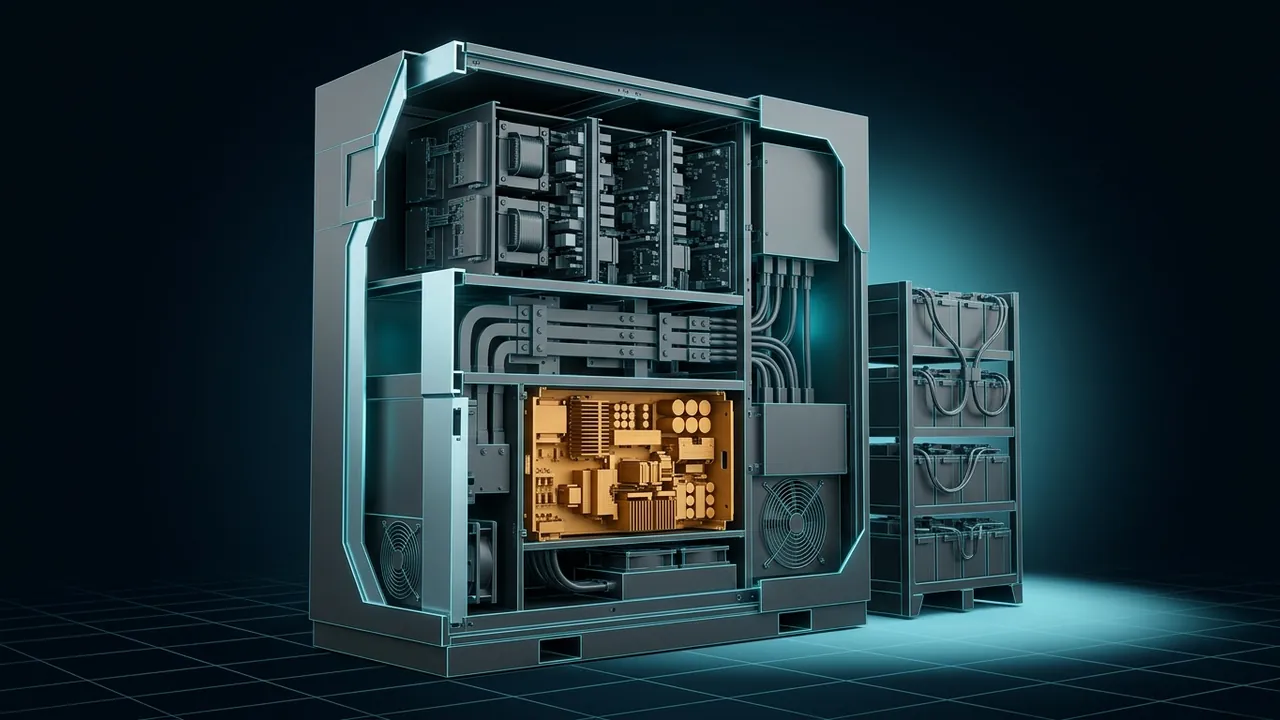
Ten seconds does not sound like much. It is about how long a good standby generator takes to start, come up to speed and accept load after the utility drops out. To a server, though, ten seconds without power is an eternity, because most IT equipment can ride through only about a sixtieth of a second. Something has to cover that gap every single time, without a hiccup. What does a data center UPS actually do, and how do batteries and flywheels compare for the job?
A data center UPS (uninterruptible power supply) keeps IT equipment running through the gap between a utility failure and the generators taking over, and it cleans up the power the rest of the time. Most large facilities use double-conversion UPS units that turn incoming AC into DC, feed a battery or flywheel on that DC bus, then build a fresh AC waveform for the load.
When the input fails, the stored energy carries the load instantly, with no transfer gap. Batteries, now often lithium-ion, typically give several minutes of runtime. Flywheels give seconds, which is enough if the generators start reliably, and they avoid many battery headaches.
What Does a UPS Do During a Power Failure?
It carries the load until something bigger can. Here is the typical sequence in a facility with standby generators:
- The utility fails or sags badly. The UPS rectifier loses its input, and the battery or flywheel starts feeding the DC bus. The inverter never stops, so the IT load sees nothing.
- The transfer switch or switchgear senses the outage, waits a moment to rule out a blip, and signals the generators to start.
- The generators reach rated voltage and frequency, usually within about 10 seconds, and the load transfers to them.
- The UPS rectifier picks up from generator power, often ramping in gradually so it does not slam the engines, and recharges the storage.
- When the utility returns and stays stable, the system transfers back and the generators cool down and stop.
The UPS has to cover steps 1 through 4. Everything else in the design, from battery size to flywheel choice, follows from how long that window could be and how many times in a row it might happen.
Why Can't Servers Just Wait for the Generator?
Because their power supplies hold only a tiny reserve. The industry reference for IT equipment tolerance is the ITIC curve. As Power Monitors explains in its overview of the CBEMA and ITIC curves, equipment built to that envelope should survive a complete loss of voltage for about one cycle. On a 60 hertz (Hz) system, one cycle is 1 ÷ 60 ≈ 0.017 seconds, or 17 milliseconds.
Compare that with a 10-second generator start. The gap is roughly 600 times longer than the ride-through. No amount of clever switching closes that gap without stored energy, which is the whole reason the UPS exists.
The Three UPS Designs, and Why Data Centers Pick One
UPS units come in three basic topologies:
- Standby (offline): the load runs on raw utility power, and the UPS switches to its inverter when power fails. Cheap, with a short transfer gap. Fine for a desktop computer.
- Line-interactive: still runs mostly on utility power, but adds voltage regulation. Common in small server rooms and network closets.
- Double conversion (online): every watt goes through the rectifier and inverter, all the time. The output is fully rebuilt, so the load is isolated from sags, swells and frequency drift on the input.
Large data centers overwhelmingly choose double conversion. It is the only one of the three with zero transfer time on a utility failure, and it shields IT gear from the rougher power that generators produce.
The cost is efficiency. Converting power twice wastes a few percent, typically somewhere in the mid-90s percent efficient at normal loads for modern large units. Many UPS models offer an "eco mode" that runs the load on the bypass path and keeps the inverter ready, pushing efficiency close to 99%. The trade is a very brief transfer when trouble hits, and operators split on whether that trade is worth it.
How Long Does a Data Center UPS Battery Last?
Two different questions hide in that one: how many minutes of runtime, and how many years of life.
Runtime in Minutes
Most battery-based data center UPS systems are designed for roughly 5 to 15 minutes at full load. That is far longer than the generator start, and the extra time is there for a failed start, a second attempt or a manual intervention.
Worked example, sizing storage for a 1,000 kW UPS module:
- Target runtime: 5 minutes at full load. Energy out = 1,000 kW × 5 ÷ 60 = 83 kWh.
- Inverter efficiency, say 95%: energy from the battery = 83 ÷ 0.95 ≈ 88 kWh.
- Aging margin of 25%, so the battery still delivers 5 minutes near end of life: 88 × 1.25 = 110 kWh.
Real sizing also adjusts for temperature and the discharge rate, since batteries deliver less energy when drained fast. Vendors run these numbers from their discharge tables.
Service Life in Years
Valve-regulated lead-acid (VRLA) batteries were the standard for decades. They are cheap and well understood, but they are heavy, sensitive to heat and need replacement every few years. A widely used rule of thumb says VRLA life roughly halves for every 15°F (about 8°C) above 77°F (25°C).
Lithium-ion has become a common choice for new builds. Vertiv says lithium-ion UPS batteries last 8 to 10 years or more, two to three times as long as VRLA, while taking less space and recharging in under four hours. Lithium iron phosphate (LFP) chemistry is generally regarded as the safest common choice. Lithium-ion still needs a proper battery management system and fire protection designed for it.
What About Flywheels?
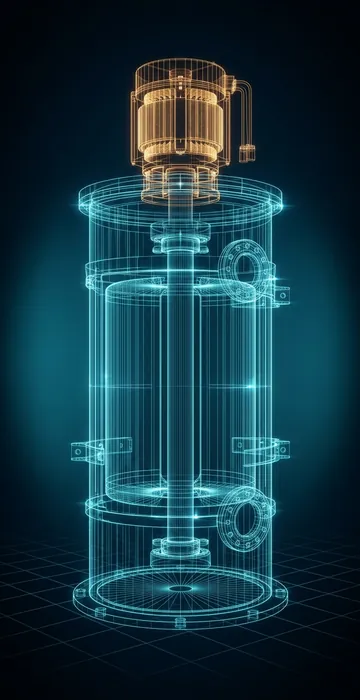
A flywheel UPS stores energy in a heavy rotor spinning at high speed, often in a vacuum housing on magnetic bearings. When power fails, the rotor drives a generator and slows down as it gives up energy. Ride-through at full load is usually somewhere around 10 to 30 seconds, depending on the model and load.
That sounds frighteningly short next to 5 minutes of batteries. The argument for flywheels is that a healthy generator system starts in about 10 seconds, and if it does not start at all, a few more minutes of battery only buys time for a graceful shutdown. Flywheels win on footprint, temperature tolerance and maintenance. They last a long time, and they do not need a cooled battery room.
The argument against is margin. If one generator fails to start and the controls need a second try, there is not much time to work with. Many designers split the difference: flywheels paired with a small battery, or batteries sized for a shorter runtime than the old 15-minute habit.
A related design, the diesel rotary UPS, puts a flywheel, a motor-generator and a diesel engine on one shaft. The flywheel covers the seconds while the engine starts and clutches in.
What Loads Does the UPS Usually Not Carry?
Big chillers and compressors, in most designs. They are large motor loads that would need a much bigger UPS, so they ride on generator power only and restart after the transfer. During those seconds, the data halls warm up a little.
To keep that from becoming a problem, many sites put the pumps and fans that move cooling water and air on their own "mechanical UPS," and some add chilled water storage tanks. The servers keep getting cool air or water while the chillers restart. An operator who forgets about cooling during a transfer learns the lesson from the temperature alarms.
How Is UPS Redundancy Arranged?
Like generators, UPS modules are arranged so one failure does not drop the load. Common schemes:
- N+1: one more module than the load needs, sharing a common output.
- 2N: two complete UPS systems, each able to carry the full load, feeding the A and B power cords of dual-corded servers.
- Distributed redundant: several UPS systems loaded partway, so the survivors absorb the load of any one that fails (for example, four systems each loaded to 75%).
The UPS also has to be paired with generators that can actually pick up its load. The way your site connects to power, whether everything runs behind the utility meter or partly on equipment the utility owns, shapes that design. If that distinction is fuzzy, our explainer on behind-the-meter vs front-of-the-meter sorts it out. Fuel and runtime for the generators themselves are covered in our guide to backup generator runtime.
The Data Center UPS Buys Seconds, and Seconds Are Everything
A data center UPS turns a utility failure into a non-event. Double-conversion units keep the load on clean, rebuilt power at all times, and stored energy carries it across the gap until the generators take over. Batteries give minutes of margin; flywheels give seconds with fewer maintenance worries.
When you choose, start with the generator system you trust, then ask how much margin you want if it misbehaves. Size for end-of-life performance, keep the batteries cool, and test the whole chain under real load. The UPS only has to work for a few seconds at a time, but it has to work every time.