How Are Data Centers Built at the Wellsite? – Containers on the Pad

A gravel pad sits in the middle of a wheat field. There is a wellhead, a few tanks, a flare burning off gas that has nowhere to go, and now a couple of white shipping containers humming next to a generator. That is what a containerized data center oil field setup looks like from the lease road. It seems simple. It isn't quite. How do people actually build a data center at the wellsite, and what has to go right for it to keep running?
A wellsite data center is a set of factory-built modules dropped on or beside a pad: a gas separation and conditioning skid, one or more natural gas generators, and steel containers full of computers with their own fans or cooling systems. The gas that would otherwise be flared feeds the generators, the generators feed the containers, and a satellite or cellular link carries data off the lease. Everything sits on skids or trailers so it can be set in days and hauled away when the well declines. The hard parts are not the computers. They are steady fuel, clean fuel, heat, dust, and a load that can ride out the hiccups of an oil well.
What Goes on the Pad?
Most of these sites use the same handful of building blocks. The names vary by vendor, but the jobs do not.
| Module | Its job | What the crew watches |
|---|---|---|
| Tie-in and meter run | Takes gas off the separator or flare line and measures it | Pressure, volume, who owns the gas |
| Gas conditioning skid | Knocks out liquids, filters, regulates pressure, sometimes removes heavy ends | Liquid carryover, dew point, filter condition |
| Generator package | Burns the gas to make electricity, usually a reciprocating engine | Load, knock, oil analysis, run hours |
| Power distribution | Transformers, breakers and cabling to the containers | Grounding, breaker trips, voltage |
| Compute containers | Racks or shelves of computers with fans or liquid cooling | Inlet temperature, dust, hardware failures |
| Communications | Satellite dish, cellular gateway or radio link | Uptime, latency, backup path |
The pieces get set by crane or winch truck, leveled on timber mats or gravel, and bolted together with flexible connections. On a good day the electrical tie-in takes longer than the setting.
The containers themselves are the "prefabricated modular" idea applied to rough ground. Schneider Electric's engineers define a prefabricated modular data center as pre-engineered subsystems that are integrated and tested in a factory and shipped on a skid or in an enclosure. That testing matters more on a lease than in a city, because nobody wants to troubleshoot a wiring mistake forty miles from the nearest parts house.
How Does Wellhead Gas Become Server Power?
Raw gas goes through cleanup, then into an engine, then out as electricity. Each step exists because wellhead gas is messier than pipeline gas.
- Separation: The well's existing separator splits oil, water and gas. The data center taps the gas downstream, often at the line that would have gone to the flare.
- Scrubbing and filtering: A scrubber vessel and coalescing filters catch the liquids and solids that ride along.
- Conditioning: If the gas is rich in propane, butane and heavier hydrocarbons, it can make an engine knock. Some sites chill the gas or run it through a skid that drops out heavy ends.
- Pressure regulation: Engines want a steady fuel pressure, and a well does not always deliver one.
- Generation: A natural gas engine turns all of that into electricity at a set voltage and frequency.
Mobile conditioning vendors such as GTUIT point out that raw wellhead gas with heavy components lowers methane number and can cause engine derates and failures, which is why trailer-mounted cleanup shows up on so many of these pads. Each vessel on a fuel gas conditioning skid has its own job, and skipping one usually shows up in the engine's oil samples.
A Quick Fuel-to-Power Example
Here is how a crew might size a site. These are made-up inputs, not numbers from any real well.
- Gas available: 500 Mcf per day (thousand cubic feet per day)
- Heating value: 1,200 Btu per cubic foot, typical of rich associated gas
- Energy per day: 500,000 cubic feet × 1,200 Btu = 600 million Btu, or 600 MMBtu
- Generator heat rate: 10,500 Btu per kWh (about 32% efficient)
- Electricity per day: 600,000,000 ÷ 10,500 = about 57,100 kWh
- Average power: 57,100 kWh ÷ 24 hours = about 2,380 kW, or roughly 2.4 MW
Most planners would not build to that full number. Rich gas may force the engines to run below nameplate, and a well's gas rate swings with oil production. Building for something like 2 MW and leaving headroom is the more honest plan.
How Big Is a Containerized Data Center in an Oil Field?
Small, by data center standards. A single pad usually supports somewhere from a few hundred kilowatts to a few megawatts, because that is what one well or a cluster of wells can feed. A big city data center can draw a hundred times more.
Container sizing follows the generator. A standard 40-foot container can be built out for anything from a few hundred kilowatts to around a megawatt of computing, depending on how densely it is packed and how it is cooled. So the example site above might run two to four containers next to two or three engines. The engines get matched to the load so each one runs near its sweet spot, with one spare when the budget allows.
Many early sites ran bitcoin miners, because mining hardware does not care where it lives and can shut off in seconds when gas pressure drops. That flexibility is the same trait that makes compute a good partner for curtailed renewable energy on the grid side. More general computing can also run at the wellsite, but it needs steadier power and better connectivity, which raises the bar for everything else on the pad.
Keeping the Machines Cool, Clean and Running
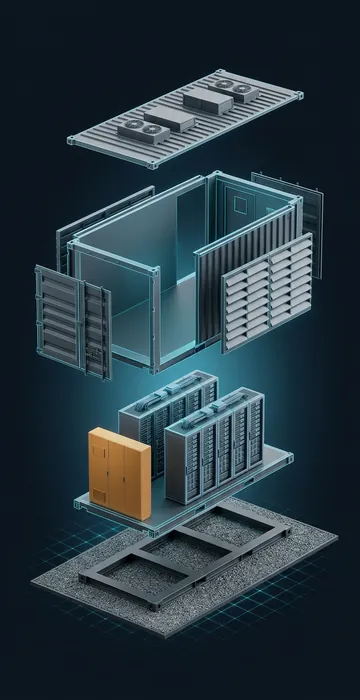
Heat and dust do more damage out here than anything else. Nearly all the power a computer draws ends up as heat, and a 1 MW container has to reject about 3.4 million Btu of it every hour.
Air-cooled containers pull outside air through filters across the hardware and push it out the other side with big fans. That works well in North Dakota in October and poorly in West Texas in August. Operators handle summer with evaporative pads, lower-density layouts, or by accepting that the hardware will throttle on the hottest afternoons. Some sites use immersion cooling, where the hardware sits in tanks of a non-conductive fluid and dry coolers reject the heat. It costs more up front, but it keeps caliche dust off the circuit boards.
Then there is the engine. A generator running on field gas needs oil changes, spark plugs and valve adjustments on a schedule, plus oil samples that tell you whether the fuel is hurting it. Remote monitoring lets a technician see trouble before a drive, but someone still has to make the drive. Plan for engine downtime the same way you plan for a dry hole: it will happen, so build the site so one engine can be down without the whole place going dark.
How Does the Data Get Off the Lease?
Usually by satellite or cellular, sometimes by a licensed radio hop to the nearest tower or fiber point. The choice depends on what the computers are doing.
- Bitcoin miners send tiny amounts of data. A modest link with decent uptime is enough.
- General computing workloads may move a lot of data and care about delay, which can rule out older high-orbit satellite service.
- Monitoring traffic for the engines, cameras and gas meters needs its own path, ideally separate from customer data.
Most good sites carry two links from different providers. A lightning strike or a cut cable should not take down the only connection when the nearest technician is two hours away.
What Happens When the Well Declines?
You load up and move. That is the whole point of putting everything on skids. Shale wells give up a large share of their output in the first year or two, and associated gas falls right along with the oil. A site that ran four containers in month three might only feed two by the end of year two.
Operators handle that a few ways:
- Tie in more wells on the same pad or neighboring pads through a short gathering line.
- Pull an engine and a container and send them to a newer well.
- Sign gas deals that cover a whole area instead of one well, so equipment can be shuffled without new paperwork every time.
The gas contract matters as much as the hardware. You need the operator on board, a clear deal on who owns the gas and what royalty applies, and permits for the engines. Air permits for generators vary by state, so check with your state regulator before the first container ships.
A wellsite data center is less like a building and more like a drilling rig: it shows up, does a job for a while and moves on.
Containers on the Pad Are Built to Leave
Building a containerized data center in an oil field starts with the gas, not the computers. Measure what the well actually makes, get a gas analysis, size the engines with room to spare, and put conditioning in front of them so they live a long life.
Then set factory-tested containers that can shrug off heat and dust, give them two ways to talk to the outside world, and keep everything on skids. When the well tapers off, and it will, the whole operation should be able to roll down the lease road to the next pad. If you are weighing a site, start with a gas test and a phone call to the operator. Everything else follows from those two answers.