How Are Cell Towers Powered Off-Grid?

A cell tower never sleeps. It has to carry calls and data at 3 a.m. in a snowstorm just as reliably as at noon in June, and some towers sit miles past the last power line. For those sites, off-grid cell tower power means making every kilowatt-hour on site, often with a fuel truck as the only lifeline. How are cell towers powered off-grid, and what keeps them on the air?
Off-grid cell towers are usually powered by diesel generators, battery banks and, increasingly, solar panels working together as a small hybrid power system. The radio equipment runs on a -48 volt DC power plant, where rectifiers turn generator AC into DC and batteries float on the same bus to carry the load without a break.
The simplest sites run a generator around the clock. Better designs cycle the generator only to recharge the batteries, then add solar to cut fuel use and run hours further. Small repeaters can run on solar and batteries alone. The job is really a fuel logistics problem as much as an electrical one.
How Does Power Flow at a Cell Site?
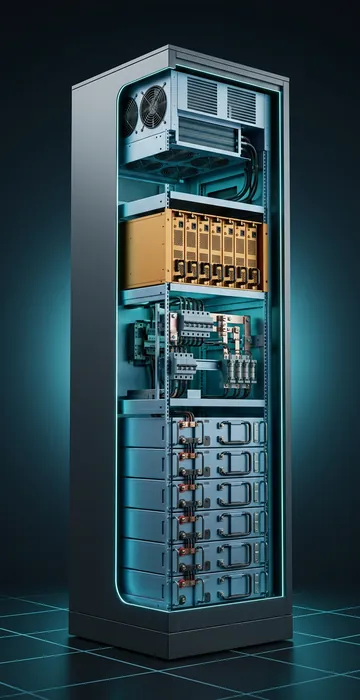
Almost every cell site, on-grid or off, is built around a DC power plant. Radios and baseband equipment run on -48 volts DC, a telecom convention that goes back to the wired telephone network. Here is the chain at a typical off-grid site:
- A generator (or solar charge controllers) supplies power.
- Rectifiers convert generator AC into -48 V DC.
- Batteries sit on the DC bus, charging when there is surplus and discharging when there is not.
- DC distribution feeds the baseband units, the radios at the top of the tower and the site controller.
- A small amount of AC power runs cooling, lights and service outlets.
Because the batteries are always connected, the radios never see a gap when a generator stops or starts. That design makes it easy to add solar later, since solar charge controllers can feed the same DC bus.
How Much Power Does a Remote Cell Tower Use?
It varies widely. A small rural site or a microwave repeater can draw a few hundred watts. A multi-carrier macro site with several radios and active cooling can draw several kilowatts. The radios scale with traffic and the number of bands, and cooling depends on the climate and whether the equipment sits in an air-conditioned shelter or an outdoor cabinet.
The load runs around the clock, which is what makes off-grid towers hard. A 2 kW continuous load is 2 kW × 24 h = 48 kWh every day, 365 days a year. That is far more than a solar-powered SCADA site, and it is why most off-grid towers still lean on fuel.
What Are the Main Off-Grid Power Setups?
Operators mix and match a handful of building blocks. The table compares the common setups.
| Setup | How it works | Fuel use | Best fit |
|---|---|---|---|
| Continuous diesel | Generator runs 24/7, second unit as standby | Highest | Short-term or legacy sites |
| Diesel plus battery (cyclic) | Generator charges batteries, then shuts off | Moderate | Most off-grid macro sites |
| Solar, diesel and battery | Solar carries much of the load, generator fills gaps | Low | Sunny regions, high fuel costs |
| Solar and battery only | No generator | None | Small, low-power repeaters |
| Fuel cell backup | Hydrogen or methanol cell runs when other sources fail | Low, when used | Backup at quiet or emissions-sensitive sites |
The GSMA's report on renewable energy for mobile towers notes that off-grid and bad-grid towers have long relied on diesel generators, and it looks at where renewables can take over in several countries. In the US and Canada, off-grid towers are less common but still show up on mountaintops, along remote highways, in oil fields and across Alaska.
Why Not Just Run a Generator All the Time?
Because a generator running a small load around the clock wastes fuel and wears itself out. Diesel engines are most efficient near their rated load. A tower drawing 2 kW from a 15 kW generator runs it at about 13% load, which burns a lot of fuel for the energy delivered and can cause wet stacking, where unburned fuel builds up in the exhaust.
Cycling fixes that. Here is an illustrative comparison using assumed fuel rates. Check your own generator's fuel curve for real numbers.
- Continuous: 24 h × an assumed 0.6 gal/h at light load = 14.4 gallons per day
- Cyclic: the generator runs at about 70% load to carry the site and recharge the batteries, about 6 hours a day at an assumed 1.1 gal/h = 6.6 gallons per day
- Difference: roughly half the fuel and about 75% fewer run hours
Fewer run hours also mean fewer oil changes and longer intervals between overhauls, which matters when every service visit is a long drive.
How Much Does Solar Help an Off-Grid Tower?
A lot, in sunny places. Solar panels feed the DC bus during the day, carrying the load and charging the batteries, so the generator starts less often. In a strong solar climate, a well-sized hybrid can shift a large share of the energy to solar and leave the generator for cloudy stretches and winter.
Solar also adds time before the fuel runs out. In an NREL study of resilient renewable energy microgrids, adding solar and batteries to a diesel-backed site added about 1.8 days of resilience, and the report notes that diesel stocks typically last only one to two days. For a tower that serves emergency calls, those extra days can matter more than the fuel savings.
The trade-off is space and up-front cost. A tower that draws several kilowatts needs a sizable array and battery bank, which may not fit on a small mountaintop lease. Our guide to solar diesel hybrid systems covers how those systems are sized and controlled.
What About Fuel Cells, Wind and Other Options?
They fill niches. None has replaced the diesel-battery-solar combination at most off-grid macro sites, but each solves a specific problem.
- Hydrogen fuel cells are used as backup power at some telecom sites. They are quiet, have few moving parts and produce only water at the site, but hydrogen cylinders have to be delivered and stored safely.
- Methanol fuel cells carry their fuel as a liquid, which is easier to haul and store, and suit long-running backup at sites that are hard to reach.
- Small wind turbines can complement solar in windy places, since wind often blows at night and in winter when solar is weak. They add moving parts and maintenance on top of a tower that already needs climbers.
- Thermoelectric generators, which turn heat from a small propane or natural gas burner directly into electricity, have long powered low-wattage radio and monitoring sites along pipelines. They make tens to hundreds of watts, enough for a repeater but not a busy macro site.
The choice usually comes down to load size, fuel access and how often a crew can get there. A site reachable only by helicopter in winter will justify options that would never pencil out beside a paved road.
What Keeps Off-Grid Towers Running Year After Year?
Monitoring and logistics. The best power design still fails if the fuel tank runs dry or a battery string quietly dies. Well-run operators watch these points remotely:
- Fuel level and fuel use rate, to plan deliveries and spot theft.
- Generator run hours, starts and alarms.
- Battery voltage, temperature and state of charge.
- Rectifier and solar controller status.
- Shelter or cabinet temperature, door contacts and intrusion alarms.
Many of those sensors send only a few bytes every few minutes, which suits low-power wireless networks. A LoRaWAN network, for example, can carry fuel level and door sensor data on tiny batteries for years. The rest of the job is planning: fuel deliveries timed before winter roads close, spare parts staged nearby, and battery replacement on a schedule rather than after a failure.
Off-Grid Cell Tower Power Is a Hybrid Game
Off-grid cell towers run on a -48 volt DC plant fed by generators, batteries and solar, arranged so the radios never notice when one source stops. Continuous diesel is simple but wasteful. Cycling the generator against a battery bank cuts fuel and wear, and solar cuts both again while adding days of reserve.
If you run an off-grid site, you already hold the two numbers that matter most: daily kilowatt-hours and gallons burned per day. Put them side by side and you can see how much a battery hybrid or a solar addition would save, and how many years it would take to pay for itself.