Can a Data Center Cool Without Water? – Dry Coolers and Closed Loops

Picture a site with cheap land, a strong gas supply and a willing county. Then the water district says no, or says yes with a number so small it barely covers the restrooms. That is when the cooling conversation gets real. Data centers have to throw away enormous amounts of heat every second, and evaporating water is the classic way to do it. Waterless cooling skips that step. Can a data center cool without water, and what does it give up if it does?
Yes. A data center can reject all its heat to the air through dry coolers, air-cooled chillers or closed loops, with no water evaporated in normal operation. The price is energy, because without evaporation the fluid can only get a few degrees cooler than the outdoor air, so hot days mean harder-working fans and compressors. It works best with warm-running servers, liquid cooling and climates without extreme heat. Many sites use hybrid units that stay dry most of the year and spray water only on the hottest afternoons.
How Does Waterless Cooling Work?
Waterless cooling works by passing warm fluid or refrigerant through a finned coil and blowing outdoor air across it. Heat moves from the warmer fluid into the cooler air, the same way a car radiator works. Nothing evaporates, so nothing needs replacing except the occasional top-up of a sealed loop.
There are a few main building blocks:
- Dry coolers, which are big fan-and-coil units that cool a closed water or glycol loop.
- Air-cooled chillers, which use a refrigeration cycle to make cold water and reject the heat through their own air-cooled condensers.
- Direct expansion (DX) systems, where room units pump refrigerant to outdoor condensers, much like a home split system on a larger scale.
- Pumped refrigerant economizers, which skip the compressor in cool weather and just pump refrigerant to the outdoor coil.
The heart of it is a closed loop. The same fluid circulates for years. Compare that with an open cooling tower, which loses water to evaporation and blowdown every hour it runs.
What Is a Dry Cooler?
A dry cooler is a heat exchanger that uses only air to cool a liquid. Warm water or glycol from the data hall flows through rows of tubes covered in thin aluminum fins. Large fans pull outside air across the fins, and the fluid leaves cooler than it arrived.
The limit is the approach temperature, the gap between the fluid leaving the cooler and the outdoor air. A well-sized dry cooler might get the fluid to within roughly 10 to 15°F of the outdoor dry-bulb temperature. On a 100°F afternoon, that means fluid around 110 to 115°F. That is far too warm to make 65°F chilled water, but it can be fine for liquid-cooled servers designed for warm water.
What Does Going Waterless Cost in Energy?
It costs more electricity on hot days, and how much depends on how warm your servers can run. If the IT can accept warm supply air or warm liquid, dry coolers handle most of the year with just fans. If the room needs cold water, compressors have to make up the difference.
Here is a rough example with labelled assumptions. Take 1 MW of IT, which is about 284 tons of cooling. Assume a water-cooled chiller plant with towers uses about 0.6 kW per ton at peak, and an air-cooled chiller uses about 1.1 kW per ton on the same hot day.
- Water-cooled: 284 tons × 0.6 = about 170 kW
- Air-cooled: 284 tons × 1.1 = about 312 kW
- Peak penalty: about 142 kW, or roughly 14% of the IT load
That penalty only applies on the hottest hours. In cool weather, both systems lean on free cooling, and the gap shrinks or disappears. Over a year, the extra energy might be modest in a mild climate and significant in a hot one.
What Are Hybrid and Adiabatic Coolers?
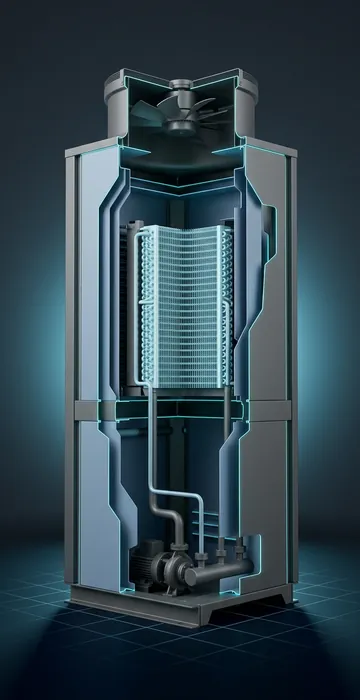
Hybrid and adiabatic coolers are dry coolers with a backup trick. They run dry most of the year. When the outside air gets hot, they wet pads in front of the coils or spray a fine mist, which cools the incoming air by evaporation before it hits the fins. That drops the effective air temperature by many degrees, exactly when you need it.
Data Center Dynamics described adiabatic cooling as the best of both worlds, citing vendor claims that such units can run dry up to 85% of the year and use up to 90% less water than cooling towers. Treat those as best-case vendor figures, but the idea is sound. You spend a little water during heat waves instead of a lot of water all year.
The U.S. Department of Energy reported a related approach at the National Renewable Energy Laboratory, where a thermosyphon hybrid cooling system was paired with evaporative towers. The dry thermosyphon side handles heat when conditions allow, and the towers only pick up what is left, cutting water use.
What Water Does a Waterless Site Still Use?
A little, and it is worth being precise about it when neighbors ask. Closed loops need an initial fill, often a water and glycol mix, plus small top-ups after maintenance. People on site need restrooms and drinking water. Some sites also wash dry cooler coils a few times a year, because dust and cottonwood fluff on the fins cut performance.
Compared with an evaporative site, these volumes are tiny. The honest phrase is "no water consumed for cooling in normal operation," which is a strong claim on its own and holds up to scrutiny.
Does Liquid Cooling Make Waterless Cooling Easier?
Yes, and this is the most important point in this article. Direct-to-chip and immersion cooling can work with coolant temperatures well above 90°F, sometimes above 110°F. At those temperatures, a dry cooler can reject heat on all but the hottest days, even in warm regions.
That flips the old trade-off. With air-cooled servers that want cold air, going waterless meant big compressors and a higher power usage effectiveness (PUE). With warm-water liquid cooling, going waterless can be cheap in both water and energy. If you are designing a new site where water is scarce, plan the servers and the heat rejection together.
Where Does Waterless Cooling Struggle?
It struggles in the places where water is often scarcest: very hot, dry regions. West Texas, the desert Southwest and similar climates see long stretches above 100°F, and dry coolers lose ground every degree the air warms. Our guide to data center cooling in a hot climate looks at how sites there balance water, power and dust.
| Situation | Waterless fit | Why |
|---|---|---|
| Cool or mild climate, any IT | Strong | Free cooling most of the year |
| Hot climate, warm-water liquid cooling | Good | Fluid temperatures stay above outdoor air |
| Hot climate, cold-air rooms | Workable, with an energy penalty | Compressors carry hot hours |
| Hot climate, tight power budget | Consider hybrid | A little water on peak days saves generator capacity |
Footprint is the other challenge. Dry coolers need a lot of coil area and space around them for airflow, so they take more land and roof than cooling towers of the same capacity. They also make fan noise, which matters if neighbors are close.
Is Waterless Cooling Worth It for Off-Grid Sites?
Often, yes. A remote site running on its own gas engines may have no municipal water at all, and trucking water is expensive and unreliable. In that case, waterless cooling is not a green bonus. It is the only realistic plan.
The key is to size generation for the hottest hour, when dry coolers are working hardest and compressors may be running. A design that looks lean at an annual PUE can come up short on the one August afternoon that matters. If peak capacity is tight, a hybrid cooler with a modest water tank for heat waves can save you an extra generator, and our guide on evaporative cooling in data centers explains how that water versus energy swap works.
Waterless Cooling Works When You Design for Warm
Going dry is a proven choice, not an exotic one. The real variable is temperature: the warmer your servers and coolant can run, the smaller the power penalty on hot days.
Where water is the scarcest resource, design for waterless cooling from the start, pair it with liquid cooling or warm air set points, and size your power for the worst afternoon of the year. If power is tighter than water, a hybrid system that sips water only during heat waves may be the smartest middle ground.