How Do Data Centers Stay Cool in West Texas Heat?
Out past Midland, August does not ask permission. Afternoons sit near or above 100°F for weeks, the wind carries half the county with it and the nearest reliable water source may be a long way off. Yet cheap land, strong gas supply and open space keep pulling data center and mining projects into that country. Data center cooling in a hot climate like this has to work on the worst afternoon, not the average one. How do data centers stay cool in West Texas heat?
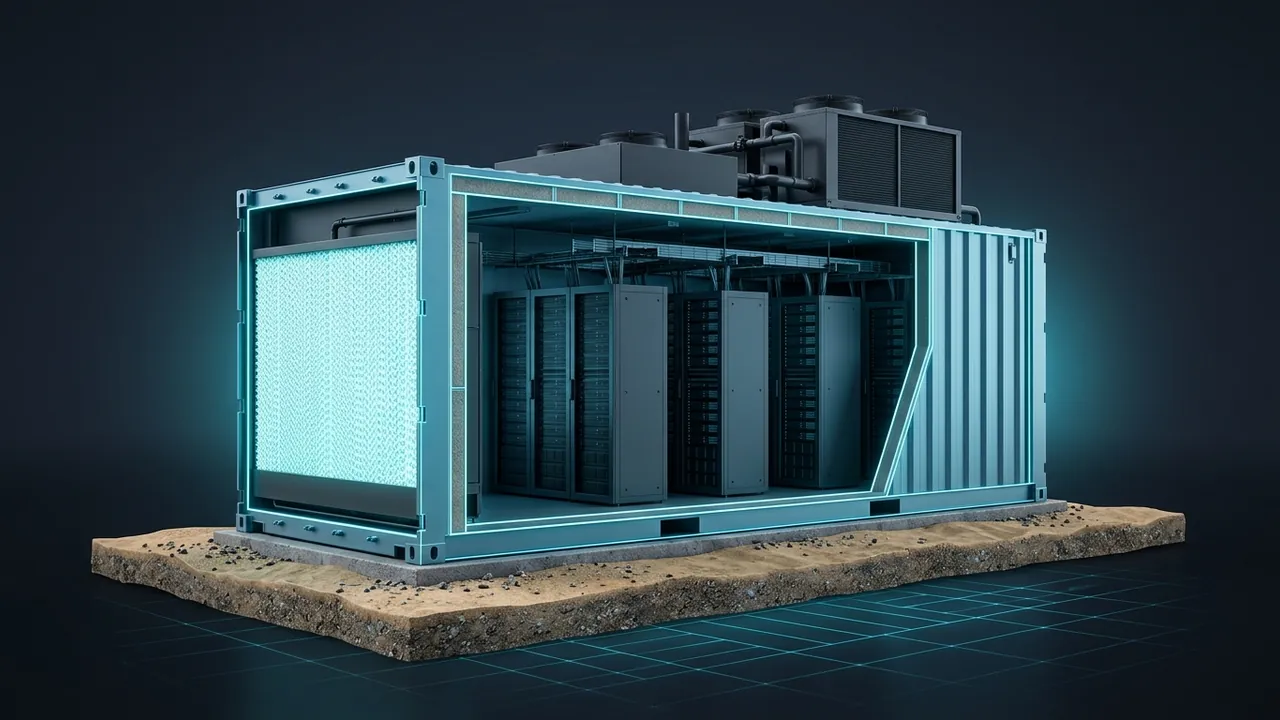
Data centers stay cool in West Texas heat by designing for the hottest hours, using the region's dry air for evaporative cooling and keeping dust out. Low humidity lets evaporative and hybrid coolers chill air far below the outdoor temperature with modest water. Warm server set points and liquid cooling let dry coolers carry much of the year with no water at all. Sites with their own gas generation also plan for engines and turbines losing output on hot afternoons.
Why Is Data Center Cooling Harder in a Hot Climate Like West Texas?
Because heat, dust and water scarcity all show up at once. Each one alone is manageable. Together they push every cooling decision toward a trade-off.
- Heat. Long runs of triple-digit afternoons shrink the hours when outdoor air can cool for free and push air-cooled equipment near its limits.
- Dust. Dry soil, wind and the occasional dust storm load filters and coat coils, which cuts airflow and cooling capacity.
- Water. Groundwater is precious and often brackish, municipal supply is limited and trucking water is costly.
- Power. Hot afternoons are also when the grid is most stressed, and when on-site generators lose rating.
There is one big advantage, though, and it matters a lot: the air is usually dry.
How Does Dry Air Help Cool a Data Center?
Dry air can soak up a lot of evaporated water, and evaporation cools. The measure that captures this is wet-bulb temperature, the lowest temperature air can reach by evaporating water into it. In dry climates, the wet-bulb sits far below the thermometer reading.
Here is a worked example. On a 100°F afternoon with 15% relative humidity, the wet-bulb temperature works out to about 67°F. A direct evaporative cooler with an assumed effectiveness of 85% can cool air by 85% of the gap between those two numbers:
- Gap: 100 − 67 = 33°F
- Cooling: 0.85 × 33 ≈ 28°F
- Supply air: 100 − 28 ≈ 72°F
That 72°F air is well inside ASHRAE's recommended range for server inlets, made with fans and water rather than compressors. Run the same math for a humid Gulf Coast day at 95°F and 50% humidity, where the wet-bulb is about 80°F, and you only get down to about 82°F. Dry heat is hard on people, but it is friendly to evaporative cooling.
Should a Hot-Climate Data Center Use Water or Not?
It depends on which is scarcer at your site, water or power, and most West Texas designs end up somewhere in the middle. Full evaporative designs use the least energy but need dependable water. Fully dry designs need almost no water but pay an energy penalty on hot afternoons.
Hybrid and adiabatic coolers are popular for that reason. They run dry when the air is mild and wet their pads only above a set temperature. Data Center Dynamics reported vendor claims that adiabatic coolers can run dry up to 85% of the year and use up to 90% less water than cooling towers. In a hot climate the dry share will be lower, but even running wet a few hundred hours a year saves a great deal of water compared with towers evaporating around the clock.
| Approach | Water | Energy on a 100°F day | Notes for West Texas |
|---|---|---|---|
| Direct evaporative air cooling | Moderate | Very low | Works well in dry air; needs strong filtration |
| Hybrid or adiabatic dry coolers | Low | Low to moderate | Good balance; pads need dust care |
| Air-cooled chillers | Near zero | High | Pick high-ambient models |
| Warm-water liquid cooling to dry coolers | Near zero | Low to moderate | Strong option for dense racks |
What Temperature Should You Design For?

Design for the hottest hours you can reasonably expect, not the average summer day. ASHRAE publishes climate design data for weather stations, including temperatures exceeded only 0.4%, 1% or 2% of the hours in a typical year, plus extreme values that show up once every several years. The 0.4% value is exceeded only about 35 hours a year.
Many data center designers go beyond the 0.4% figure and plan for extreme temperatures, because even a few hours of lost cooling is unacceptable. Then they check the equipment ratings. Air-cooled chillers are commonly rated at 95°F entering air, so a site that will see 105°F or more needs units built and rated for high ambient conditions, with that capacity loss accounted for.
Keep Hot Air From Coming Back
One mistake I see often is outdoor equipment packed too tightly. Condensers and dry coolers blow hot air out the top. If they sit close together, against walls or in a pit, that hot air gets pulled back into neighboring intakes, and a unit rated for 115°F suddenly sees 125°F at its coil. Give equipment room to breathe, mind the prevailing wind and model the yard if the layout is tight.
How Do You Handle Dust and Sand?
You filter hard and plan for maintenance. ASHRAE's gaseous and particulate contamination guidelines recommend minimum efficiency reporting value (MERV) 11 to 13 filters on outdoor air brought into a data center and MERV 8 on recirculated air. In dusty country, operators often add a coarse pre-filter so the finer filters last longer.
Dust also coats outdoor coils and evaporative pads, which reduces cooling capacity just when you need it most. Coil washing and pad replacement belong on the maintenance calendar, with extra checks after storms. Our guide to data center dust filtration covers filter grades, sealing and harsh-site details.
What About On-Site Power in the Heat?
Heat also hits the power plant. Gas turbines are rated at ISO conditions of 59°F at sea level, and output falls as inlet air warms and thins, so a turbine on a 105°F afternoon makes noticeably less power than its nameplate. Reciprocating engines are less sensitive but still derate at high temperatures and altitude, depending on the model.
That is a double hit. The cooling load peaks at the same hour that generation capacity dips. Sites handle it by sizing generation for hot-day ratings, cooling turbine inlet air with evaporative media or chillers, and in some cases using an absorption chiller that turns engine or turbine exhaust heat into chilled water. Heat you were going to throw away ends up fighting the heat outside.
Small Moves That Help on Hot Days
Not every fix needs a new chiller. A few practical habits make a real difference:
- Run supply air toward the upper end of the recommended range, within server specs.
- Contain hot or cold aisles so you are not overcooling the room.
- Use light-colored roofs and shade outdoor equipment where airflow allows.
- Pre-cool the hall slightly before the hottest hours if your controls and IT allow it.
- Keep spare filters and pad sets on site before summer starts, not after the first storm.
Staying Cool in West Texas Heat Is About the Worst Afternoon
West Texas gives you a gift and a bill at the same time. The dry air makes evaporative cooling cheap, and the heat, dust and thin water supply charge you for it. The sites that do well plan cooling and power together around the hottest hour, when cooling demand peaks and generators lose rating.
Your first homework for any hot, dry site is the ASHRAE climate design data for the nearest weather station. With that in hand, decide whether water or power is your tighter constraint. Every other cooling choice follows from those two answers.