What Is an Absorption Chiller? – Turning Waste Heat Into Cooling
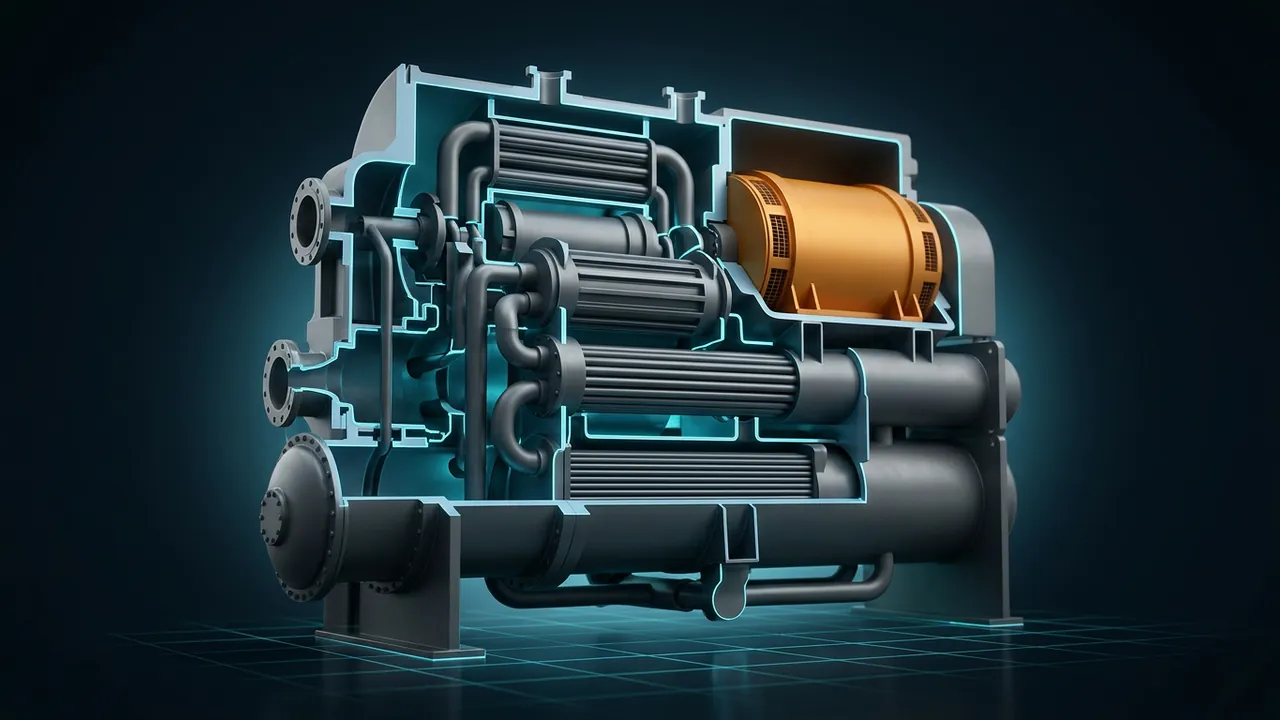
A gas engine plant has a heat problem it rarely advertises: only about 40% of the fuel's energy leaves as electricity. The rest goes up the stack and out through the radiators as heat. Meanwhile, the data center next door is spending megawatts on chillers to get rid of its own heat. It is natural to wonder whether one problem could solve the other. What is an absorption chiller, and can it really turn waste heat into cooling?
An absorption chiller makes chilled water using heat instead of a large electric compressor. Yes, it can turn waste heat into cooling: hot water, steam or engine exhaust drives the cycle, and a single-effect unit makes roughly 0.7 units of cooling per unit of heat. Most use water as the refrigerant and a lithium bromide salt solution as the absorbent. On paper they are far less efficient than electric chillers, but the heat is often free because it would otherwise be thrown away.
How Does an Absorption Chiller Work?
An absorption chiller works by boiling water at very low pressure to make it cold, then using a salt solution and heat to recycle that water vapor. There is no big compressor. A small pump moves liquid, and heat does the heavy lifting.
The common lithium bromide (LiBr) and water machine has four main sections:
- Evaporator. Inside a deep vacuum, water boils at around 40°F. As it boils, it pulls heat out of the building's chilled water loop flowing through tubes.
- Absorber. The water vapor is soaked up by a concentrated lithium bromide solution, which has a strong appetite for water. Absorbing the vapor keeps the pressure low so the evaporator keeps boiling.
- Generator. A pump sends the now-diluted solution to the generator, where the heat source boils the water back out.
- Condenser. That vapor condenses back into liquid water, giving up its heat to cooling tower water, and returns to the evaporator to start again.
Think of the absorber and generator as a "thermal compressor." In an electric chiller, a motor-driven compressor raises refrigerant pressure. In an absorption chiller, the salt solution and heat do the same job.
What About Ammonia Absorption?
Ammonia and water machines use ammonia as the refrigerant and water as the absorbent. Because ammonia can boil far below freezing, these are used for industrial refrigeration and ice making. Data centers only need chilled water around 45 to 65°F, so lithium bromide machines are the usual choice.
What Is the Difference Between Single-Effect and Double-Effect Chillers?
The difference is how many times the machine reuses its heat. A single-effect chiller uses the heat once. A double-effect chiller, also called two-stage, uses a hot first generator and then reuses the vapor's heat to drive a second, lower-temperature generator. That reuse nearly doubles the cooling per unit of heat, but it needs a hotter source.
The U.S. Department of Energy's fact sheet on absorption chillers for CHP systems gives these typical values:
| Type | Typical COP | Typical heat source |
|---|---|---|
| Single-effect (single-stage) | 0.70 to 0.79 | Hot water around 190 to 240°F or low-pressure steam |
| Double-effect (two-stage) | 1.35 to 1.42 | Higher-pressure steam or hot exhaust gas |
The same fact sheet notes units ranging from about 5 to 3,000 tons of cooling. COP, or coefficient of performance, is the cooling output divided by the heat input. For comparison, a good electric centrifugal chiller has a COP around 5 to 7, but that is cooling per unit of electricity, which is a much more valuable form of energy.
Why Use an Absorption Chiller Instead of an Electric Chiller?
Because it lets you cool with energy you already paid for. If heat from a generator's jacket water or exhaust would otherwise be dumped through radiators, running it through an absorption chiller turns a waste stream into chilled water and cuts the electric load of the cooling plant.
Other advantages come along for the ride:
- Very little electricity, just pumps and controls, so the cooling plant takes less of your generation capacity.
- Quiet operation with little vibration, since there is no large compressor.
- Water as the refrigerant, which means no ozone-depleting or high global warming potential refrigerants.
How Much Cooling Can Generator Waste Heat Make?
A fair amount. Here is a worked example with labelled assumptions, for a single 3 MW gas engine generator:
- Assume 40% electrical efficiency. Fuel input = 3 MW ÷ 0.40 = 7.5 MW of fuel energy.
- Combined heat and power systems typically reach about 65% to 75% total efficiency, according to the U.S. Department of Energy's combined heat and power basics. Assume 75% total, so useful heat = 7.5 × (0.75 − 0.40) ≈ 2.6 MW.
- Run that heat through a single-effect chiller at a COP of 0.7: 2.6 × 0.7 ≈ 1.8 MW of cooling, or about 520 tons.
- An electric chiller at an assumed 0.6 kW per ton would need about 310 kW to make the same cooling.
So that one engine's waste heat could cool roughly 1.8 MW of IT load and free up around 300 kW of electrical capacity that would otherwise feed chillers. Across a plant of ten engines, the numbers start to matter. This is the core idea behind trigeneration, also called combined cooling, heat and power, and our guide to combined heat and power covers the broader concept.
Can Absorption Chillers Help Gas Turbines on Hot Days?
Yes, and this is one of their most useful jobs at a power plant. A gas turbine makes less power as its inlet air warms, because hot air is less dense and the machine moves less mass through it. Chilling the inlet air on a hot afternoon brings some of that lost output back.
An absorption chiller driven by the turbine's own exhaust heat can supply that inlet cooling with very little electricity. For a site that runs its own turbines in a hot climate, the same chilled water plant can serve both the turbine inlets and the data hall, which is a tidy way to fight the hot-day double hit of rising cooling load and falling generator output.
What Are the Downsides of Absorption Chillers?

The biggest is heat rejection. An absorption chiller has to dump both the heat it removed from the building and the heat that drove it. Using the example above:
- Absorption: 1.8 MW cooling + 2.6 MW heat input ≈ 4.4 MW to reject.
- Electric: 1.8 MW cooling + 0.3 MW compressor power ≈ 2.1 MW to reject.
That means roughly twice the cooling tower capacity, and if those are evaporative towers, roughly twice the water evaporated for the same cooling. At a water-scarce site, that can be a deal breaker or force a costly dry-cooled design.
Other trade-offs are worth knowing. Absorption chillers are larger and heavier than electric chillers of the same tonnage, cost more up front and respond more slowly to load changes. The lithium bromide solution can crystallize if conditions drift too far, for example when condenser water gets too cold or heat input is too high, so controls matter. And the cooling only exists while the heat source runs, so a site needs a plan for when engines are down for maintenance.
Can a Data Center Run an Absorption Chiller on Server Heat?
Usually not directly. Server exhaust air typically leaves at roughly 95 to 115°F, and even warm-water liquid cooling loops usually run well below the 190°F or so that a single-effect machine wants. The heat is plentiful but too low in temperature to drive the cycle well.
That is why absorption chillers at data centers almost always pair with a hotter source, typically on-site generators. The low-grade heat that servers produce is a different puzzle, often better suited to heat pumps and district heating. Our guide to data center waste heat looks at those options and where they make sense.
An Absorption Chiller Turns Waste Heat Into Cold Water, With Strings Attached
The low COP is a distraction. What decides whether an absorption chiller pays is whether you have steady, hot waste heat and enough water or tower capacity to reject roughly twice the heat of an electric plant.
For a site with generators running most of the time, ask the engine vendor how much jacket water and exhaust heat each unit sheds, then compare an absorption chiller's cooling against the extra tower capacity and water it needs. Where water is available and the generators run steadily, the math can be very good. Where water is scarce or the engines only run as backup, electric chillers usually remain the simpler answer.