What Is LCOE? – Levelized Cost of Energy in Plain English
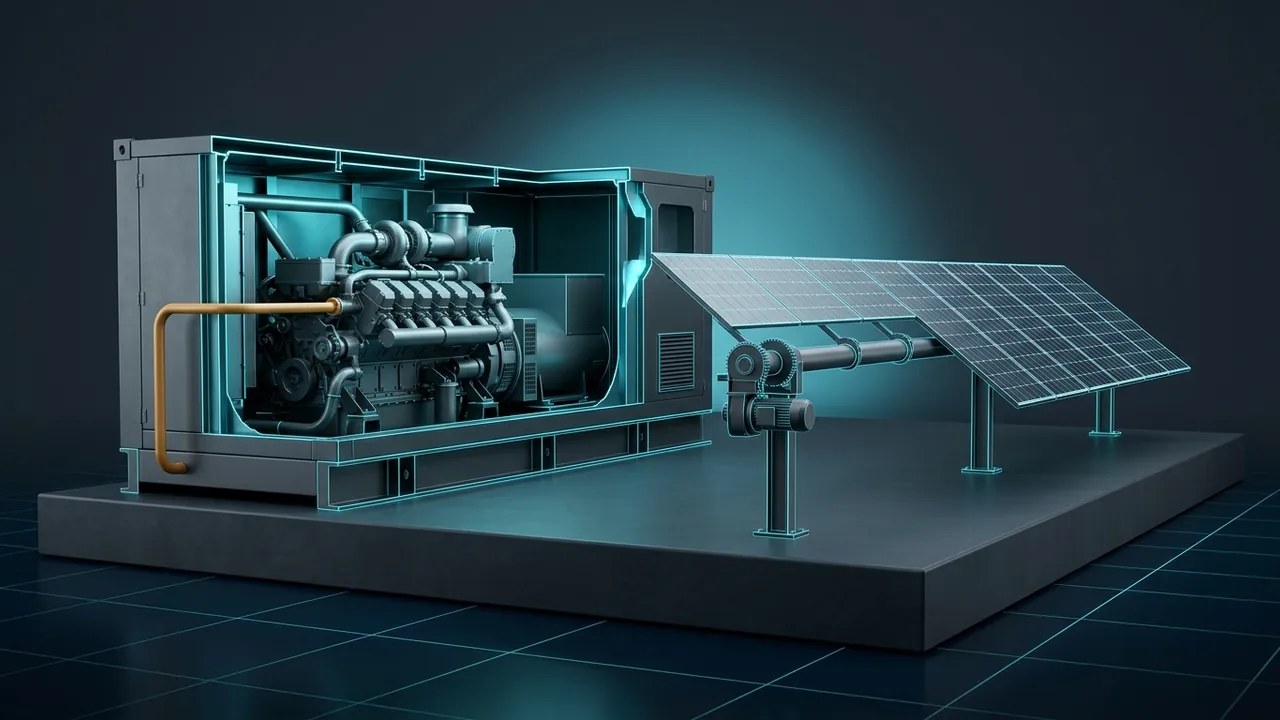
One power plant costs a fortune to build and almost nothing to run. Another is cheap to build but burns fuel every hour it operates. A third lasts forty years, and a fourth needs replacing in fifteen. Comparing them on sticker price alone tells you nothing useful, and comparing them on fuel cost alone is just as misleading. Energy people needed one number that rolls all of that together. What is LCOE, the levelized cost of energy, and how should you use it?
The levelized cost of energy (LCOE) is the average cost of producing each unit of electricity over a power plant's life, found by dividing the present value of all its costs by the present value of all the energy it generates, and it is usually stated in dollars per megawatt-hour.
Because it spreads construction, financing, fuel and maintenance over lifetime output, LCOE lets you compare a solar farm, a gas plant and a wind project on the same scale. But it ignores when the power is produced and whether it is available on demand, so use it to compare, not to decide on its own.
What Does Levelized Cost of Energy Mean in Plain Terms?
It is the break-even price. If you sold every MWh a plant produces at its LCOE, you would cover all your costs, including a return on the money you borrowed or invested, by the end of its life.
"Levelized" means the uneven costs over time, a big construction bill up front and steady fuel and maintenance later, are converted into one flat price per MWh. The U.S. Energy Information Administration publishes a regular report on levelized costs of new generation resources that explains the method and compares technologies, and it is a good reference for the formal definitions.
What Is the LCOE Formula?
The full version sums discounted costs and discounted energy year by year:
LCOE = (sum over all years of costs ÷ (1 + r)^t) ÷ (sum over all years of energy ÷ (1 + r)^t)
Here r is the discount rate and t is the year. Discounting reflects the fact that a dollar today is worth more than a dollar in twenty years.
For quick estimates, a simplified version gives nearly the same answer when costs are steady:
- Capital part = (capital cost × capital recovery factor) ÷ annual MWh
- Fixed O&M part = fixed O&M per year ÷ annual MWh
- Fuel part = heat rate × fuel price
- Add variable O&M per MWh
The capital recovery factor (CRF) turns an up-front cost into an equal annual payment. The formula is r(1 + r)^n ÷ ((1 + r)^n − 1), where n is the number of years. At 7 percent over 25 years, 1.07^25 is about 5.427, so CRF = 0.07 × 5.427 ÷ 4.427 = about 0.0858.
How Do You Calculate LCOE Step by Step?

Here are two worked examples using the simplified method. All inputs are illustrative, chosen to show how the math works rather than to quote current prices.
Example 1: A Solar Plant
Example inputs: $1,100 per kW capital cost, $20 per kW-year fixed O&M, 25 percent capacity factor, no fuel, 7 percent discount rate and 25-year life.
- Annual energy per kW: 8,760 hours × 0.25 = 2,190 kWh, or 2.19 MWh.
- Annual capital charge: $1,100 × 0.0858 = about $94 per kW-year.
- Capital part: $94 ÷ 2.19 = about $43 per MWh.
- Fixed O&M part: $20 ÷ 2.19 = about $9 per MWh.
- LCOE: about $52 per MWh.
Example 2: A Combined-Cycle Gas Plant
Example inputs: $1,000 per kW capital cost, $15 per kW-year fixed O&M, $3 per MWh variable O&M, heat rate of 6,500 Btu/kWh, gas at $3.50 per MMBtu, 60 percent capacity factor, same 7 percent and 25 years.
- Annual energy per kW: 8,760 × 0.60 = 5,256 kWh, or 5.256 MWh.
- Capital part: ($1,000 × 0.0858) ÷ 5.256 = about $16 per MWh.
- Fixed O&M part: $15 ÷ 5.256 = about $3 per MWh.
- Fuel part: 6.5 MMBtu per MWh × $3.50 = about $23 per MWh.
- Variable O&M: $3 per MWh.
- LCOE: about $45 per MWh.
The heat rate converts directly: 6,500 Btu per kWh is the same as 6.5 MMBtu per MWh. The EIA's FAQ on power plant efficiency and heat rates explains that conversion and the 3,412 Btu that one kWh contains.
Why Does Capacity Factor Change LCOE So Much?
Because fixed costs get divided by output. Run the same gas plant half as many hours and its capital and fixed O&M costs per MWh double, while fuel per MWh stays the same.
The chart below shows the solar example, the gas example at 60 percent capacity factor and the same gas plant at 30 percent.
Dollars per MWh, 7% discount rate, 25-year life
- Capital
- Fixed O&M
- Fuel
- Variable O&M
Model: illustrative inputs stated in the article; CRF 0.0858 at 7% over 25 years; not market prices
View the data
| Capital | Fixed O&M | Fuel | Variable O&M | Total | |
|---|---|---|---|---|---|
| Solar, 25% CF | $43.1 | $9.1 | $0.0 | $0.0 | $52.2 |
| Gas combined cycle, 60% CF | $16.3 | $2.9 | $22.8 | $3.0 | $45.0 |
| Gas combined cycle, 30% CF | $32.7 | $5.7 | $22.8 | $3.0 | $64.2 |
At 30 percent, the gas plant's LCOE rises from about $45 to about $64 per MWh. That is why plants that run only at peak times, called peakers, carry high LCOE values even when they are cheap to build.
How Much Do Interest Rates and Fuel Prices Matter?
A lot, and they hit different technologies differently. Capital-heavy plants, such as solar, wind and nuclear, are most sensitive to the discount rate. Fuel-heavy plants, such as gas peakers, are most sensitive to fuel price.
Rerun the solar example at a 10 percent discount rate. The CRF rises to about 0.110, the capital part to about $55 per MWh, and the LCOE to about $64 per MWh. That is a 23 percent jump from a three-point change in financing cost, with nothing physical changing at all. For the gas plant, each $1 per MMBtu change in gas price moves LCOE by $6.50 per MWh.
Is There an LCOE for Batteries?
Yes, with a twist. Batteries do not generate energy; they store it and give most of it back. Analysts use a cousin of LCOE, the levelized cost of storage (LCOS), which divides the battery's lifetime costs by the energy it discharges.
LCOS depends heavily on how often the battery cycles. A battery that cycles once a day spreads its cost over far more MWh than one used only for emergencies. It also leaves out the cost of the energy used to charge it, so to compare stored solar against gas, you add the solar LCOE (raised a little to cover round-trip losses) to the storage cost.
What Does LCOE Leave Out?
LCOE measures the cost of producing energy, not the value of that energy or the cost of fitting it into a system. Key gaps include:
- Timing: a MWh at 6 p.m. on a hot day is worth more than one at noon in spring.
- Firmness: a gas plant can run on demand; solar and wind cannot without storage or backup.
- Location: transmission and interconnection costs are often excluded.
- Integration: backup capacity, storage and grid services needed to keep the system reliable.
- Risk: fuel price swings, policy changes and construction overruns.
- Taxes and incentives: results change a lot depending on whether credits are included.
The EIA pairs LCOE with a second measure, the levelized avoided cost of electricity (LACE), which estimates the value a new plant provides to the grid. Comparing cost with value gives a fairer picture than cost alone.
How Should You Use LCOE for an On-Site Project?
Use it to compare options that deliver the same service. If a remote site needs power every hour of the year, compare gas engines against solar plus enough storage and backup to match that reliability, not against solar alone. Our guide to on-site power cost runs that comparison with worked numbers.
The same lifetime-cost thinking applies beyond power plants. Teams weighing a modular data center against a traditional build, or leasing against owning, can levelize capital and operating costs over the expected life to compare them fairly.
Levelized Cost of Energy: A Ruler, Not a Verdict
The levelized cost of energy turns every power plant's mix of capital, fuel and maintenance costs into a single price per MWh. It is the best quick tool for comparing technologies, and the simplified formula is easy to run yourself.
Just remember what it ignores: timing, firmness, location and risk. When you see an LCOE figure, ask what capacity factor, discount rate and fuel price sit behind it. Then run your own numbers with your own inputs, and compare options that actually deliver the same service.