Can LNG or CNG Power a Remote Site? – The Virtual Pipeline

Some sites have everything going for them except a gas line. Maybe it is a mine, a remote compute site or a new plant that needs power two years before the pipeline company can show up. The fuel exists, of course. It just lives a few hundred miles away. Can LNG or CNG trucked in by road really power a remote site, and when does a virtual pipeline make sense?
Yes, a virtual pipeline of trucked liquefied natural gas (LNG) or compressed natural gas (CNG) can power a remote site, and it works best for small to mid-sized loads or as a bridge until a real pipeline arrives. Trucks carry gas from a liquefaction plant or compressor station to on-site storage, where it is vaporized or decompressed and fed to engines or turbines. The approach is fast to set up and needs no right-of-way, but every unit of fuel costs more than pipeline gas once you add processing and trucking. The truck count climbs quickly with load, so a few megawatts is very manageable while a large plant would need a steady parade of trailers.
What Is a Virtual Pipeline?
A virtual pipeline is a supply chain that moves natural gas by truck, rail or ship instead of by pipe. The gas starts somewhere connected to the pipeline grid, gets packed into a dense form and rides to a site that has no pipe of its own. At the far end, equipment turns it back into ordinary low-pressure gas.
The term caught on as a way to describe these delivery systems serving places pipelines do not reach. A 2015 GE Reports article described trucked CNG and LNG supply as something that could be set up in roughly 6 to 18 months, compared with pipelines that cost on the order of $1 million per kilometer, and pointed to remote mines and small grids as natural customers.
LNG vs CNG: What Is the Difference?
Both are natural gas. The difference is how they are packed for the trip.
| Feature | CNG | LNG |
|---|---|---|
| How it is stored | Gas squeezed to about 3,000 to 3,600 psi | Gas chilled to about −260°F (−162°C) until it turns liquid |
| Volume reduction | Under 1% of its volume at normal pressure | About 1/600 of its gas volume |
| Trailer type | High-pressure tube or composite cylinder trailers | Insulated cryogenic tankers |
| On-site equipment | Decompression skid with heaters | Cryogenic storage tanks and vaporizers |
| Best fit | Shorter hauls and smaller loads | Longer hauls and larger loads |
LNG packs far more energy per trailer, so it wins as distance and load grow. CNG avoids the expense and complexity of cryogenics and can be sourced from a compressor station near any decent pipeline, so it often wins for short runs and modest loads.
How Many Trucks Does It Take?
This is the math that decides most projects. Start with fuel demand, then divide by what a trailer carries. Here is an illustrative example with stated assumptions.
Assume a 5 MW site running around the clock at a heat rate of 9,000 Btu/kWh:
- Fuel per hour: 5,000 kW × 9,000 Btu/kWh = 45 million British thermal units (MMBtu).
- Fuel per day: 45 × 24 = 1,080 MMBtu.
- LNG holds roughly 83,000 Btu per gallon (higher heating value), so the site burns about 1,080 ÷ 0.083 ≈ 13,000 gallons a day.
- Assume an LNG trailer delivers about 10,000 usable gallons: roughly 1.3 trailers per day.
- Assume a CNG trailer delivers about 350 thousand cubic feet (Mcf), or about 363 MMBtu at 1,037 Btu per cubic foot: roughly 3 trailers per day.
Now scale it to 20 MW. Fuel quadruples to 4,320 MMBtu per day, which works out to about 5 LNG trailers or about 12 CNG trailers every single day, holidays and ice storms included. Real trailer capacities vary by design and local weight rules, so plug in your supplier's numbers. The pattern holds, though: the virtual pipeline works nicely at a few megawatts and gets heavy fast after that.
Where Does the Trucked Gas Come From?
CNG usually comes from a compression station, sometimes called a mother station, built on a pipeline with spare capacity. Big compressors squeeze the gas into trailers that are swapped in and out on a schedule. Because pipelines run almost everywhere in gas country, a CNG source can often be found within a reasonable haul.
LNG comes from liquefaction plants, which are far fewer and farther between. Some are small-scale plants built to supply trucks, mines and remote users. Others are utility peak-shaving plants that liquefy gas in summer and store it for winter, and some sell surplus to outside buyers. Fewer sources means longer hauls and more concentration risk, so check how many plants can actually serve your site before you sign.
What Equipment Sits at the Site?
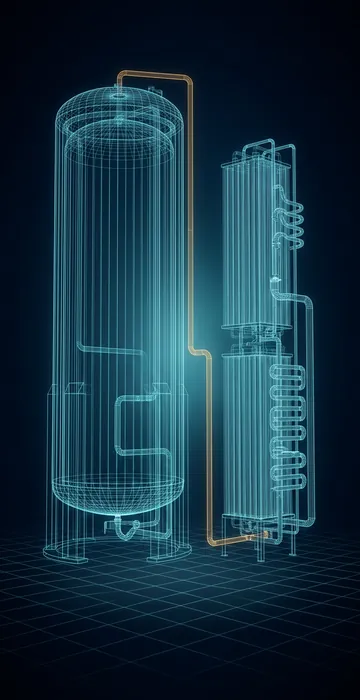
The receiving end turns dense gas back into fuel the engines can use.
For LNG, that means insulated storage tanks, vaporizers that warm the liquid back into gas (often finned ambient-air units, sometimes heated ones for cold climates or high flow), pressure controls and a way to manage boil-off. LNG slowly warms in storage even in a good tank, and the gas that boils off has to be used, recompressed or safely vented under the site's permits.
For CNG, the trailer itself often serves as storage. Crews connect it to a decompression skid that drops the pressure in stages. Because cutting pressure from thousands of psi down to engine pressure causes deep cooling, these skids include heaters, usually fed by engine jacket water or a small boiler. Clean Energy Fuels' OffgridCNG product sheet describes this kind of on-site pressure reduction and pitches trucked CNG to plants from 0.5 to 200 MW up to 500 km beyond a pipeline, though those are vendor claims worth checking against your own truck math.
Codes and Safety
Both fuels are handled under fire codes such as NFPA 52 and NFPA 59A, along with federal hazardous materials rules for transport. Cryogenic liquid causes severe cold burns and displaces oxygen in enclosed spaces, and high-pressure gas has its own hazards. Site design, setbacks and operating procedures are a job for specialists, and the local fire marshal will want to see them.
What Does a Virtual Pipeline Cost?
The delivered price stacks up from several pieces: the gas itself at a nearby hub, liquefaction or compression, trucking by the mile, on-site equipment and the margin of whoever runs the service. Because of those added steps, trucked gas almost always costs more per MMBtu than the same gas delivered by pipe. How much more depends heavily on distance, volume and contract length, so get quotes rather than relying on rules of thumb.
The fair comparison is not trucked gas against pipeline gas. It is trucked gas against the alternatives the site actually has, such as diesel, waiting years for a pipeline lateral, or not building at all. Against diesel, natural gas is often cheaper per unit of energy and much cleaner burning. Against waiting, speed has real value.
When Does a Virtual Pipeline Make Sense?
A virtual pipeline tends to fit when one or more of these is true:
- The load is small or moderate, roughly the low tens of megawatts or less.
- A pipeline is coming, but not soon enough, so trucked gas serves as a bridge.
- The site is temporary, like a construction camp, a drilling program or a seasonal operation.
- The site needs a backup to a single pipeline connection.
- The project is replacing diesel generators to cut fuel cost and emissions.
It struggles when the load is large and permanent, when roads close for weeks every winter or when a pipeline tap is a few miles away.
How Do Sites Protect Against Delivery Gaps?
Trucks get delayed. Plants shut down for maintenance, drivers quit and snow closes highways. A virtual pipeline site lives or dies by how much fuel it keeps on hand and how many supply points it can draw from.
Common protections include storage sized for several days of full-load burn, contracts with more than one supply plant and engines that can switch fuels. A dual fuel generator that can fall back on diesel gives a site one more layer if both the gas trucks and the backup trucks are stuck. Some operators also design the load so a slice of it can be shed when fuel runs low.
The Virtual Pipeline: A Bridge, Not Always a Destination
Can LNG or CNG power a remote site? For a few megawatts, absolutely, and the setup is faster than almost any pipeline. As load climbs into the tens of megawatts, the truck count, fuel premium and delivery risk climb too, and the virtual pipeline starts to look more like a bridge than a permanent answer.
Run the truck math with real trailer capacities, price the delivered gas against diesel and against the pipeline timeline, and size storage for the worst week of weather you expect. Then decide whether trucks are the plan or the plan until the pipe shows up.